A new partnership between IMMA and the Transport for Ireland (TFI) Network brings Art to the streets of Dublin

Pictured at the launch of a new partnership between IMMA and the Transport for Ireland (TFI) Network are Dagogo Hart, poet; Daryl Daniels, National Transport Authority; Rachael Gilbourne, IMMA; Richie Keane, Fatima Groups United The Poetry Vigilantes; and artist Alberta Whittle. Photo Mark Stedman.

The Irish Museum of Modern Art (IMMA) and the National Transport Authority (NTA), under its Transport for Ireland (TFI) brand, are excited to announce a new partnership that will bring an inspiring mobile artwork directly into the daily journeys across Dublin city.

Art in Motion: Routes and Roots is a creation by artist Alberta Whittle, developed in collaboration with poet Dagogo Hart and community  writers group Fatima Groups United’s The Poetry Vigilantes.

Together, they have created a vibrant artwork that will wrap one of TFI’s buses, transforming the familiar public transport vehicle into a moving canvas.

Launching this summer, the Art in Motion: Routes and Roots bus will operate across the TFI network in Dublin, bringing a burst of creativity to the capital. Each day, thousands of passengers and many more who see the bus along the network will encounter art in a fresh and unexpected way. This collaboration makes contemporary art a visible and accessible part of the city’s daily movement, reaching communities throughout Dublin.

Developed through a series of poetry workshops, the bus artwork is inspired by themes explored in Fisherwoman, Fisherwoman, an exhibition currently on show at IMMA. The exhibition combines the work of contemporary artist Alberta Whittle (b. 1980) and renowned painter Camille Souter (1929–2023). During the workshops, led by Whittle and Hart, participants from The Poetry Vigilantes composed original poetry responding to the exhibition and their own lived experiences. These poetic fragments will appear across the bus wrap artwork, celebrating community voices and the power of poetry and art to connect and inspire.

Speaking on the partnership announcement, Anne Shaw, CEO of the NTA, said: “Transport for Ireland is delighted to work with IMMA to bring this inspiring project onto our network, where art can meet people as part of their everyday journeys. The TFI network connects communities across Dublin, and this collaboration shows how public transport can also connect us through creativity, culture and shared experience.”

Annie Fletcher, Director of IMMA, said: “IMMA is thrilled to partner with NTA’s Transport for Ireland brand. This exciting partnership is a Radically Public gesture that invites everyone, wherever they are, to engage with creativity in their daily lives. It’s a powerful meeting point between public infrastructure, artistic vision and community spirit.”

Art in Motion: Routes and Roots underscores IMMA’s commitment to expanding access to art and connecting with audiences beyond the Museum’s walls. Through this collaboration with Transport for Ireland, contemporary art becomes woven into the city’s everyday rhythm, bringing colour, language, and imagination to the streets of Dublin.

14 April 2026

ENDS

Additional Notes for Editors

About Alberta Whittle
B. 1980; Bridgetown Barbados; lives and works in Glasgow, Scotland. Barbadian-Scottish. Whittle’s multifaceted practice is preoccupied with developing a personal response to the legacies of the Atlantic slave trade, unpicking its connections to institutional racism, white supremacy and climate emergency in the present. Against an oppressive political background Whittle aims to foreground hope and engage with different forms of resistance. Whittle received her MFA from the Glasgow School of Art (2011); PhD at the University of Edinburgh (2024); and is currently a Research Associate at The University of Johannesburg. She has exhibited and performed in various solo and group shows internationally and represented Scotland in the 59th Venice Biennale (2022). She is the recipient of numerous awards including the Margaret Tait Award winner (2018/19); a Turner Bursary, Frieze Artist Award and Henry Moore Foundation Artist Award (2020); and Paul Hamlyn Award for Artists (2022).

About Dagogo Hart
Dagogo Hart is a Nigerian-Irish writer, poet, and theatre-maker based in Ireland. His work spans poetry, theatre, film, and education – rooted in performance but designed to resonate beyond the stage. He has featured on everything from TV to film and bar basements, led poetry workshops and showcases across Ireland and West Africa, and is author of Lantern Smoke, 2025, a children’s book with Gill Books. His acclaimed play MMANWU explores grief and cultural identity, while his new play PALMFIST continues his powerful interrogation of masculinity, violence, and vulnerability. Hart is also co-founder of WeAreGriot, a collection committed to platforming Black Irish voices through performance poetry, storytelling, and collaboration.

About Fatima Groups United
Fatima Groups United Family Resource Centre represents residents and community projects in Fatima and Herberton, Dublin 8. Since 1995, FGU has supported the physical and social regeneration of the area. FGU provides services in health, wellbeing, education, employment, arts, childcare, counselling, family support, information, advice, and advocacy. Fatima Poetry Vigilantes is a poetry group organised by Fatima Groups United. They won the Creative Lives Ireland Award in 2022 for Dance Til Dán – a film celebrating community through poetry and dance. They organise frequent Poetry Cafés and Poetry Trains.

About NTA/TFI
The National Transport Authority is a statutory non-commercial body, which operates under the aegis of the Department of Transport. Established in 2009, the NTA’s core function is around the planning, development and funding of sustainable transport modes – public transport and active travel – on a national basis. NTA’s remit also extends to the regulation of commercial bus services, as well as the Small Public Service Vehicle (SPSV) sector and vehicle clamping.

Transport for Ireland (TFI) is the public-facing brand of the NTA, used to deliver and promote Ireland’s integrated public transport network across bus, rail, Luas and active travel services.

About IMMA
Founded in 1991, IMMA is Ireland’s National Cultural Institution for Modern and Contemporary Art located in the Royal Hospital Kilmainham. Its vibrant, bold, and diverse programme comprises exhibitions, commissions, and event-based projects by leading Irish and international artists, as well as a rich engagement and learning programme which together provides audiences of all ages the opportunity to connect with contemporary art and unlock their creativity. IMMA is also the home of the National Collection of Modern and Contemporary Art of over 4,700 artworks by Irish and international artists. IMMA makes this national resource available through exhibitions at IMMA and other venues nationally and internationally, engagement and learning programmes and digital resources.

Minister Patrick O’Donovan TD announces appointments to the Board of the Irish Museum of Modern Art (IMMA)

The Minister of Culture, Communications and Sport, Patrick O’Donovan TD, is today announcing the appointment of five new members to the Board of the Irish Museum of Modern Art (IMMA).

The new appointees are:

  • Ramatoulaye Adama Diallo
  • Eibhlín Morley
  • Catherine Opdebeeck
  • Brendan O’Sullivan
  • Barry Scannell


These appointments are each for five years and follow an open call for expressions of interest and subsequent assessment process operated by Publicjobs.

The details of the current Board members are available at this link: Irish Museum of Modern Art

Commenting on the appointments, Minister Patrick O’Donovan said: “I am delighted to appoint five candidates of the calibre of Ramatoulaye, Barry, Catherine, Brendan and Eibhlín to serve on the IMMA Board and congratulate them on their appointments.  I know their wide-ranging knowledge and expertise will be of great benefit to the organisation and to the cultural community. 

“Boards are central to the governance, oversight and strategic direction of all our National Cultural Institutions. I wish our newest appointees all the very best during their terms on the Board of IMMA and would like to express my gratitude to each of them, and also to the existing members of the Board, for giving so generously of their time and bringing their strength and depth of experience to bear in guiding this important National Cultural Institution”.

ENDS.

Press and Information Office
An Roinn Cultúir, Cumarsáide agus Spóirt
The Department of Culture, Communications and Sport
Tel: 01 6437610
Email: [email protected]
Website:  Department of Culture, Communications and Sport

Note for Editors:
The Board of Trustees of IMMA consists of a maximum of twelve members, all of whom are appointed by the Minister for Culture, Communications and Sport.  Details of the current Board members are available at this link: Irish Museum of Modern Art

Ms Ramatoulaye Adama Diallo is an experienced board director and investment committee member with over 25 years of leadership experience in finance, technology, and governance across Europe, Africa, and the Middle East. She has held senior roles with global organisations including Orange and Google and currently serves on several regulated financial services boards in Ireland and internationally. Deeply interested in art, culture, and creative expression, she is passionate about supporting IMMA’s mission to remain an open, inclusive, and globally connected space for dialogue and discovery.

Dr. Barry Scannell is an expert in AI law and policy, specialising in intellectual property, AI compliance and governance, data protection, and commercial contracts. A Partner in the Technology Law Group at William Fry, one of Ireland’s leading law firms, Barry advises major Irish and international organisations on the legal and regulatory challenges posed by AI technologies and is a recognised voice in public discourse on AI and its implications for the creative industries.

Barry holds a PhD in AI and copyright and plays an important role in helping shape Ireland’s AI policy as a member of the Government-appointed AI Advisory Council, where he chairs its Working Group on AI and the Creative Sector. He has deep roots in the creative industries – as Director of Legal Affairs and Regulatory Compliance at IMRO, the Irish Music Rights Organisation, he worked at the intersection of technology, rights management, licensing, and cultural policy. He served on the Global Policy Committee of CISAC, the international body representing authors’ societies and collective management organisations worldwide, and chaired its working group on AI and copyright. Barry has addressed global forums including the World Intellectual Property Organisation’s (WIPO) ongoing conversation on AI and copyright, and is a regular contributor to national and international news and media. He also sits on the Law Society of Ireland’s Intellectual Property and Data Protection Committee

Ms Catherine Opdebeeck has worked in design and construction, across both the private and public sectors, for the past 20 years. As a practicing Architect she has been involved in the delivery of award winning cultural and museum buildings, always with a focus on design innovation and resilience. Catherine is currently Director of Programme and Procurement at the Grangegorman Development Agency. She brings skills and experience in the area of sustainability extending from environmental and technical considerations, social engagement to corporate compliance and reporting. She is a graduate of University College Dublin, the Technological University of Delft and the UCD Smurfit Business School.

Mr Brendan O’Sullivan brings over a decade of professional legal experience as a qualified solicitor with legal, regulatory and governance roles across the financial services sector. He currently serves at senior executive level in CCH; an investment holding company and as a non-executive director and Audit Committee member of Lotus Care Limited; a provider of residential care services for children and adults with intellectual disabilities. As well as investment experience and a record of civic and cultural sponsorship, he brings expertise in corporate governance, risk management and compliance, alongside a strong commitment to cultural engagement.

Ms Eibhlín Morley is Co-Founder of Cara Advisory, a consultancy specialising in fundraising, strategy, and organisational transformation for non-profits across Ireland and globally. She has led and advised on campaigns raising hundreds of millions in private and corporate philanthropy and sponsorship, working with clients across education, arts, heritage, religion and health. She is an expert in end-to-end project management, external communications and storytelling, executive coaching, training, and facilitation across the non-profit sector.

Eibhlín is Co-Founder of Abú! Performing Arts, a Mayo-based performing arts academy serving the West of Ireland. She is an alumna of Trinity College Dublin, UCD Smurfit School, and Queen’s University Belfast.

Fógraíonn an tAire Patrick O’Donovan TD ceapacháin chuig Bord Áras Nua-Ealaíne na hÉireann (IMMA)

Tá an tAire Cultúir, Cumarsáide agus Spóirt, Patrick O’Donovan TD, ag fógairt inniu go bhfuil cúigear comhaltaí nua ceaptha ar Bhord Áras Nua-Ealaíne na hÉireann (IMMA).

Is iad na ceapaithe nua ná:

  • Ramatoulaye Adama Diallo Uasal
  • Eibhlín Morley Uasal
  • Catherine Opdebeeck Uasal
  • Brendan O’Sullivan Uasal
  • An Dr Barry Scannell

Tá na ceapacháin seo go léir ar feadh thréimhse cúig bliana agus rinneadh iad i ndiaidh gairm oscailte ar léiriú spéise agus próiseas measúnaithe arna fheidhmiú ag Publicjobs ina dhiaidh sin.

Tá sonraí faoi chomhaltaí reatha an Bhoird ar fáil ag an nasc seo: Áras Nua-Ealaíne na hÉireann

Ag trácht ar na ceapacháin, dúirt an tAire Patrick O’Donovan:“Tá ríméad orm an cúigear iarrthóirí den scoth Ramatoulaye, Barry, Catherine, Brendan agus Eibhlín a cheapadh chun freastal ar Bhord IMMA agus gabhaim comhghairdeas leo as a gceapachán. Táim cinnte go mbeidh a n-eolas forleathan agus a saineolas de thairbhe iontach don eagraíocht agus don phobal cultúrtha.

“Tá ról lárnach ag boird i rialachas, maoirseacht agus treo straitéiseach ár bhForas Cultúir Náisiúnta go léir. Guím gach rath ar ár gceapaithe nua le linn a dtréimhse ar Bhord IMMA agus ba mhian liom mo bhuíochas a ghabháil leo go léir, agus le comhaltaí reatha an Bhoird chomh maith, as a gcuid ama a thabhairt go fial agus a neart agus a dtaithí a thabhairt leo chun an Foras Cultúir Náisiúnta tábhachtach seo a threorú”.

 CRÍOCH.

Oifig Preasa agus Faisnéise
An Roinn Cultúir, Cumarsáide agus Spóirt
The Department of Culture, Communications and Sport
Teil: 01 6437610
Ríomhphost: [email protected]
Suíomh gréasáin: An Roinn Cultúir, Cumarsáide agus Spóirt

Nóta d’Eagarthóirí:

Bíonn dáréag comhaltaí ar a uasmhéid ar Bhord Iontaobhaithe IMMA, agus déantar gach duine acu a cheapadh ag an Aire Cultúir, Cumarsáide agus Spóirt. Tá sonraí faoi chomhaltaí reatha an Bhoird ar fáil ag an nasc seo: Áras Nua-Ealaíne na hÉireann

Is stiúrthóir boird agus comhalta coiste infheistíochta ag a bhfuil breis agus 25 bliain de thaithí ceannaireachta san airgeadas, sa teicneolaíocht, agus sa rialachas ar fud na hEorpa, na hAfraice agus an Mheánoirthir í Ramatoulaye Adama Diallo Uasal. Bhí róil shinsearacha aici le heagraíochtaí domhanda lena n-áirítear Orange agus Google agus faoi láthair tá sí ag freastal ar roinnt bord seirbhísí airgeadais rialaithe in Éirinn agus ar fud na cruinne. Tá an-dúil aici san ealaín, sa chultúr agus sa léiriú cultúrtha, agus tá sí chun tacú le misean IMMA go díograiseach chun go mbeith sé fós mar spás atá oscailte, ionchuimsitheach agus ceangailte ar bhonn domhanda le haghaidh comhphlé agus fionnachtana.

Is saineolaí é an Dr Barry Scannell le dlí agus beartas IS, agus déanann sé sainfheidhmiú ar mhaoin intleachtúil, comhlíonadh agus rialachas IS, cosaint sonraí, agus conarthaí tráchtála. Is Comhpháirtí i nGrúpa Dhlí na Teicneolaíochta ag William Fry, ceann de na dlíghnólachtaí is mó in Éirinn, é Barry agus tugann sé comhairle do chomhlachtaí móra Éireannacha agus idirnáisiúnta maidir leis na dúshláin dhlíthiúla agus rialála atá ann mar gheall ar theicneolaíochtaí IS agus aithnítear é mar dhuine aitheanta sa dioscúrsa poiblí ar IS agus an tionchar atá aici ar na tionscail chruthaitheacha.

Tá PhD san IS agus cóipcheart ag Barry agus tá ról tábhachtach aige i múnlú bheartas IS na hÉireann mar chomhalta de Chomhairle Chomhairleach IS, arna ceapadh ag an Rialtas, agus é ina chathaoirleach ar Ghrúpa Oibre maidir le IS agus an Earnáil Chruthaitheach. Tá dlúthbhaint aige leis na tionscail chruthaitheacha – mar Stiúrthóir Gnóthaí Dlí agus Comhlíonadh Rialála ag IMRO, an tEagras Um Chearta Cheolta, áit a raibh sé ag obair ag an méid a bhíonn i bpáirt ag an teicneolaíocht, an bhainistíocht cheart, an ceadúnú agus an beartas cultúrtha. D’fhreastail sé ar Choiste Beartais Domhanda de CISAC, an comhlacht idirnáisiúnta a dhéanann ionadaíocht do shochaithe údar agus d’eagraíochtaí comhbhainistíochta domhanda, agus rinne sé cathaoirleacht don ghrúpa oibre maidir le IS agus cóipcheart. Labhair Barry ag fóraim dhomhanda lena n-áirítear ag comhrá leanúnach na hEagraíochta Dhomhanda um Maoin Intleachtúil (EDMI) maidir le IS agus cóipcheart, agus cuireann sé go rialta le nuacht agus le na meáin náisiúnta agus idirnáisiúnta. Tá sé ar Choiste um Maoin Intleachtúil agus Cosaint Sonraí Dhlí-Chumann na hÉireann chomh maith

D’oibrigh Catherine Opdebeeck Uasal i réimse an deartha agus na tógála, ar fud na n-earnálacha príobháideacha agus poiblí, le 20 bliain anuas. Mar Ailtire a bhíonn ag cleachtadh, bhí páirt aici i dtabhairt chun críche foirgneamh cultúrtha agus iarsmalainne a bhuaigh duaiseanna, agus bíonn béim aici ar an nuálaíocht deartha agus ar an athléimneacht i gcónaí. Faoi láthair is Stiúrthóir Cláir agus Soláthair í Catherine le Gníomhaireacht Forbartha Ghráinseach Ghormáin. Tugann sí léi scileanna agus taithí i réimse na hinbhuanaitheachta ó ghnéithe comhshaoil agus teicniúla, rannpháirtíocht shóisialta go comhlíonadh corparáideach agus tuairisciú. Is céimí an Choláiste Ollscoile, Baile Átha Cliath, Technological University of Delft agus Scoil Ghnó Smurfit COBÁC í.

Tugann Brendan O’Sullivan Uasal breis agus deich mbliana de thaithí ghairmiúil sa dlí leis mar dhlíodóir cáilithe ag a bhfuil róil dhlíthiúla, rialála agus rialachais ar fud earnáil na seirbhísí airgeadais. Faoi láthair tá ról feidhmiúcháin sinsearach aige le CCH; comhlacht sealbhaíochta infheistíochta agus is stiúrthóir neamhfheidhmiúcháin agus comhalta de Choiste Iniúchóireachta Lotus Care Limited é; soláthraí seirbhísí cúraim chónaithigh do leanaí agus do dhaoine fásta ag a bhfuil míchumais intleachtúla. Mar aon le taithí infheistíochta agus stair d’urraíocht chathartha agus chultúrtha, tugann sé leis saineolas i rialachas corparáideach, bainistiú riosca agus comhlíonadh, taobh le tiomantas láidir don rannpháirtíocht chultúrtha.

Is Comhbhunaitheoir Cara Advisory í Eibhlín Morley Uasal, sainchomhairleoireacht a shainfheidhmíonn i mbunathrú tiomsaithe airgid, straitéise agus d’eagraíochtaí neamhbhrabúis ar fud na hÉireann agus na cruinne. Threoraigh sí agus thug sí comhairle d’fheachtais lena mbailíodh na céadta milliún i ndaonchairdeas agus in urraíocht phríobháideach agus chorparáideach, agus d’oibrigh sí le cliaint ar fud an oideachais, na n-ealaíon, na hoidhreachta, an chreidimh agus na sláinte. Is saineolaí í sa bhainistíocht tionscadal ó cheann ceann, sa chumarsáid sheachtrach agus sa scéalaíocht, sa chóitseáil feidhmiúcháin, san oiliúint agus san éascú ar fud na hearnála neamhbhrabúis.

Is Comhbhunaitheoir Abú! Performing Arts, acadamh na dtaibh-ealaíona lonnaithe i Maigh Eo lena bhfreastalaítear ar Iarthar na hÉireann, í Eibhlín. Is céimí Choláiste na Tríonóide, Baile Átha Cliath, Scoil Ghnó Smurfit COBÁC agus Ollscoil na Banríona Béal Feirste í.

IMMA Acknowledges the Outstanding Contributions of Outgoing Board Members

IMMA outgoing Board Members, 2026.

The Irish Museum of Modern Art (IMMA) extends its sincere appreciation to several long‑serving Board members who have recently completed their terms of service. IMMA warmly recognises the dedication, expertise, and commitment of Margot Lyons, Mary Apied, Gerard Byrne, Dermod Dwyer, Eva Kenny, and Sinéad O’Sullivan, each of whom has played a central role in guiding the museum’s strategic direction and enriching cultural life in Ireland.

Appointed by the Minister for Culture, Communications and Sport, these Board members brought diverse experience spanning the arts, public service, governance, finance, cultural advocacy, and community engagement. Their leadership has strengthened IMMA’s mission to connect audiences and art, providing an extraordinary space in Ireland where contemporary life and contemporary art connect, challenge, and inspire one another.

Ali Curran, Chair of the IMMA Board, said: “On behalf of the Board, I want to express our profound gratitude to Margot, Mary, Gerard, Dermod, Eva, and Sinéad. Their expertise, energy, and unwavering commitment have shaped IMMA through periods of growth, innovation, and significant achievement. Their collective impact can be felt in a stronger, more resilient IMMA, an institution that continues to champion creativity, accessibility, and public engagement. We are deeply thankful for their service.”

Annie Fletcher, Director of IMMA, said: “It has been a privilege to work alongside such a committed and inspiring group of Board members. Their leadership has touched all areas of the museum’s work from building the National Collection to organisational strategy. They have supported IMMA through moments of expansion, reflection, and transformation, always driven by a shared belief in the importance of contemporary art in public life. We extend our heartfelt thanks and wish each of them every success in their future endeavours.”

Collectively, these outgoing Board members have helped steer IMMA through key phases of development, ensuring the museum’s continued relevance, stability, and ambition. IMMA expresses its deepest thanks for their wisdom, commitment, and enduring contributions to the museum and to the wider cultural community.

1 April 2026

ENDS

IMMA launches Technologies of Peace: Art and Transition in Contemporary Europe (1989–2026) the first major public manifestation of a four-year research programme exploring the concept of peace.

Sheena Barrett, Head of Research & Learning, IMMA, at the launch of a four-year research programme The Technologies of Peace.

The Technologies of Peace, a major research programme exploring political transition, democratic fragility, and the aesthetics of peace through exhibitions, artist residencies, symposia, co-commissions, research and publications was launched today (Tuesday 10 March 2026) at the Irish Museum of Modern Art (IMMA).

This multi-year programme will begin to unfold at IMMA this year as a flagship exhibition for the European Presidency, with later iterations in the North and the UK. The exhibition, The Technologies of Peace: Art and Transition in Contemporary Europe (1989 – 2026), aims to explore the concept of peace, the tools of peace and how they are deployed through an artistic lens. It will draw parallels between Ireland’s complex political history with those of our European counterparts that have had similar trajectories in transitioning from post-conflict into democratic states of peace and stability. The exhibition which opens at IMMA on 12 September 2026 and runs until 9 May 2027, presents artists from across Europe whose work traces the complex processes through which peace is formed, challenged, and sustained. The exhibition spans themes of identity, reconciliation, civic repair, trauma, memory, and the long aftermaths of conflict, foregrounding peace not as a conclusion but as an ongoing political and cultural process.

Drawing on artistic responses to political transitions in Ireland, Greece, Poland, Romania, Spain, Cyprus, Portugal and beyond, the exhibition asks what the “technologies” of peace might be today. These are not mechanical tools but the structures, aesthetics, and intentions through which societies design and cultivate peaceful life, from legal frameworks and political negotiations, to language, publishing, architecture, and institutional behaviour.

Over the next four years IMMA will bring together exhibitions, research, artist residencies, public programmes, and new commissions to explore how artistic practice contributes to civic repair in societies shaped by dictatorship, civil unrest, and conflict. Rooted in IMMA’s longstanding commitment to research-driven contemporary practice, Technologies of Peace positions art as a vital site for reflection, negotiation, and the imagining of inclusive democratic futures.

To mark the launch, IMMA Director, Annie Fletcher and Dr Glenn Loughran, artist researcher on IMMA’s Dwell Here Residency Programme discussed the role that artistic and cultural practices play in healing societies, fostering reconciliation, and creating space for collective reflection beyond the limits of political and legal systems. At a time when democratic norms across Europe are under renewed strain, their conversation underscored the urgency of cultural engagement as a means to address fragmentation, cultivate dialogue, and articulate shared futures.

This special event also included Recording History: Notes from the Field with Dr Isobel Harbison, art historian and Research Associate at IMMA. Dr Harbison introduced her oral history project interviewing artists and filmmakers who were active in the North of Ireland from 1968, including some audio excerpts and observations from her encounters. Funded by the Shared Island Civic Society Fund, Ecclesiastical Ireland and The Benefact Group through the Movement for Good, and the Heritage Council, in partnership with Ulster Museum and the Public Records of Northern Ireland (PRONI), Dr Harbison’s research with IMMA expands on the museum’s commitment to supporting nuanced understandings of conflict and its cultural and material legacies, and will offer an important resource for future research on the conditions and networks of creative production that yield art in, or despite, conflict. Recording History will further unfold at public events at the Ulster Museum on Friday 10 and Saturday 11 April 2026.

Annie Fletcher, Director of IMMA, said: “Over the next four years IMMA will be forging ambitious new partnerships with researchers, artists and institutions across the world. Technologies of Peace brings together artistic practices that reveal peace as something actively produced through dialogue, through memory, through the infrastructures that hold societies together. As Europe navigates profound political tension, this project asks how cultural institutions can model forms of openness, care, and democratic imagination that feel urgently needed.”

ENDS

For media inquiries, please contact: 
Monica Cullinane E: [email protected] T: 086 2010023
Patrice Molloy E: [email protected] T: 086 2009957

IMMA presents a major exhibition pairing the distinct art practices of renowned artist Camille Souter and contemporary artist Alberta Whittle

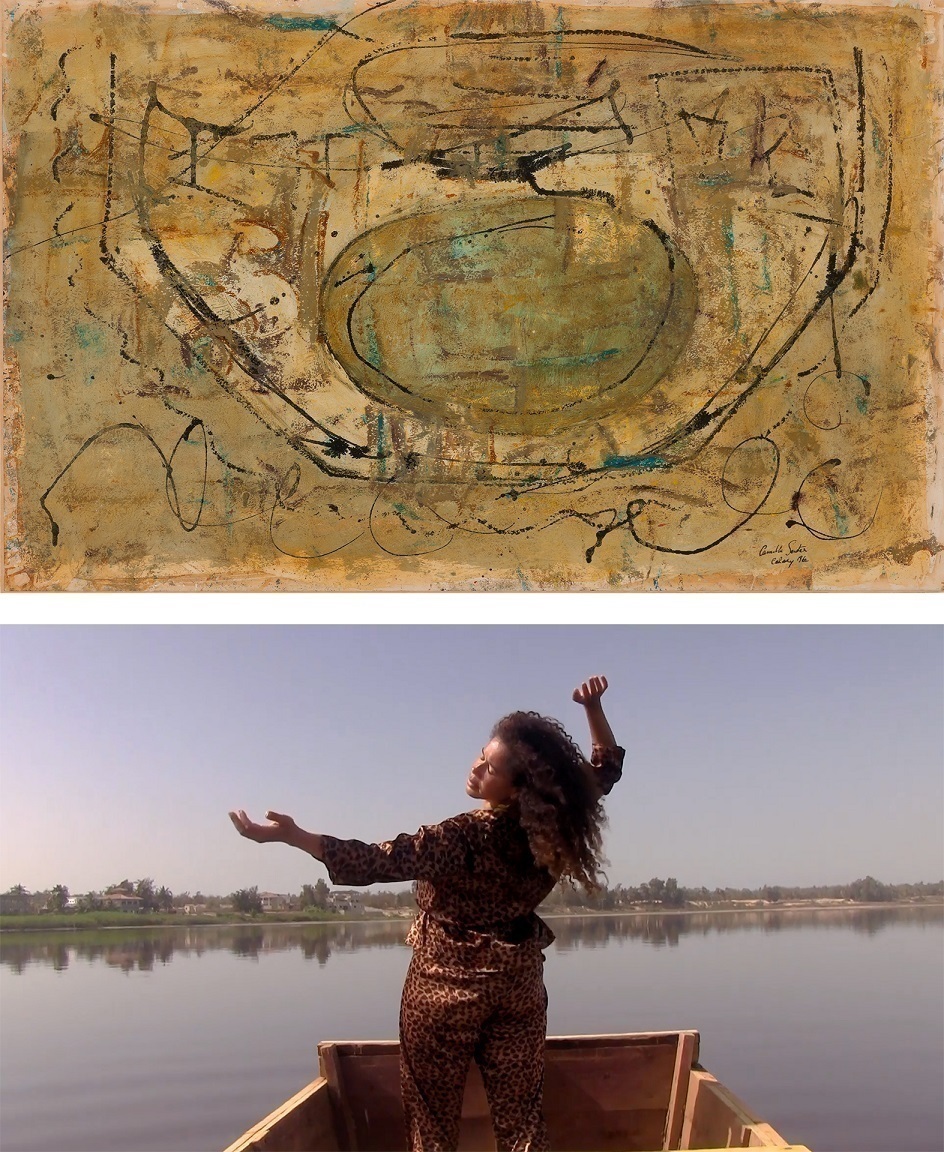
Top image: Camille Souter, We All Went Down to the River, 1962, Oil on paper laid on board, 63 x 102 cm. Collection of the Arts Council/An Chomhairle Ealaíon © Estate of Camille Souter, IVARO Dublin, 2026. Bottom image: Alberta Whittle, Between a Whisper and a Cry, 2019 (still), HD film, 41 minutes, Courtesy of the artist and The Modern Institute/Toby Webster Ltd., Glasgow

Fisherwoman, Fisherwoman brings together two distinct art practices – of painter Camille Souter (1929–2023) and contemporary artist Alberta Whittle (b. 1980) – that insist upon working against the grain. Spanning a period of 70 years, the works in this thematic exhibition range from painting, collage and watercolour to immersive film, sculptural installation and live performance. The exhibition opens at IMMA (Irish Museum of Modern Art) on Friday 6 March 2026. 

One of the largest exhibitions of British-born, Irish artist Souter’s work to date, it features works-on-paper from the 1950s as well as one of her final paintings, alongside previously unseen archival materials and sketches by the artist. Installation works by Whittle have been specially reimagined and refabricated by the artist for IMMA’s galleries, including a new sculptural installation, in what is the first showing of the Barbadian Scottish artist’s practice in Ireland.  

Where Souter and Whittle meet in Fisherwoman, Fisherwoman, we see layered intersections of ecological and humanitarian concerns. Both artists call attention to urgent issues of extraction and land use, geology and climate, industrialisation and labour, and movement and migration. They each create work from their own personal and local experiences, yet it is shaped by an unerring global awareness. At the same time, these artists’ practices are singular–they contrast in form and style to one another and hold different emphasis. Whittle leans towards the political, charging Souter’s prescient socially engaged works, while Souter’s intense care and curiosity for the natural world extends Whittle’s in turn. These different levels of emphasis bring nuance and texture to the exhibition, adding a productive complexity for visitors to unfold from their own position. 

Among the key works on display, Souter’s unflinching painting The slaughtered cow, ten minutes dead (1973), as well as her war series paintings, Desert Shield–Gulf War (1991) and We don’t want to see blood (2004), are significant. Whittle’s search for refuge in an increasingly unstable world in between a whisper and a cry (2019) and her calls for care as resistance in Invest in Love (2020) similarly ask us to bear witness to the raw hostility of humanity, but never without tenderness and empathy. There is a sense of searching for a means for restoration and transformation, be it in the face of exploitation of land for economic gain or destroyed ancestral legacies. Paintings by Souter such as The Last of the Radicio (1964) and Forgotten Island near Venice (1964) criticise humanity’s failure to respect our natural resources. Whittle’s work asks us to confront unsettling realities: in the words of writer Ama Josephine Budge, to “dive in and re/collect ourselves, if necessary, bone by bone.”  

Works reimagined by Whittle for the exhibition include RESET (2021), shown in an expanded form with installation elements on show in IMMA’s galleries, the film screened outdoors, and a live performance taking place on IMMA’s grounds. Her coil work Totems of Brass (Part one) (2023) has been dramatically extended in length in response to the architecture of IMMA’s House Galleries, while installation Belly of the beast ((continuing echoes from across the water)) (2026), has been entirely refabricated for the space of the exhibition, and the multimedia installation between a whisper and a cry (2019) is now accompanied by a new, related sculptural installation titled Memorial for “The Great Carew” aka Neville Denis Blackman (sargassum hues) (2019–2026).  

Carnival, poetry and magic are bearers of wayward joys and hope in the exhibition. Souter’s Make Believe of all this Winter (1964) and Whittle’s Only the magic and the dream are true (2023) hang side-by-side in synergy, and likewise Finding Pleasure in my Diamonds (2023) by Whittle speaks back to Souter’s Buon Divertimento Chioggia (1958). While these artists are unafraid of the darkness of humanity, they also seek fissures where joy and light seeps through to dream and make-believe new ways of being. In this way, these women become fishers. Diving into cracks to unearth silenced or wilfully forgotten truths, both past and present, they conjure up better worlds for us, on a search for truth, respect, justice and love. 

Curator Rachael Gilbourne said, “Fisherwoman, Fisherwoman tells a story of courage and compassion. Through the work of Souter and Whittle, we confront the traumas of our time – from the plundering of the earth and the oceans to the terror of war and colonialisation – yet their voices swell with empathy and a careful hope for the future. It is a real privilege to listen and learn from these artists. They call for curiosity and complexity in the face of monoculture and hype. We hope the exhibition offers the freedom to think deeply, and to imagine strategies of nuance and co-existence.”  

Alberta Whittle said, “Working with the memory of Camille Souter and her creative legacy has been fascinating and inspiring. Her approach to radical thinking through her brush has shadowed me in my own studio practice across the water in Glasgow. I am grateful for the opportunity to think expansively with her children, curator Rachael Gilbourne and the wonderful IMMA team.” 

Coinciding with the preview of Fisherwoman, Fisherwoman on 5 March, IMMA Talks presents a roundtable conversation exploring the exhibition’s themes and the practices of artists Camille Souter and Alberta Whittle. Speakers include artist Alberta Whittle, art historian Dr Sarah Kelleher, and curator Rachael Gilbourne.  

Whittle’s film RESET (2020) will be screened on Living Canvas at IMMA at key moments over the duration of the show, and on 21 June, Whittle’s performance work RESET (2021–2026), with choreographer and performer Mele Broomes, will take place live across the museum’s grounds to celebrate the Solstice, as part of Summer at IMMA. 

A wider public programme of related workshops and screenings will also run in parallel with the exhibition.  

The exhibition is accompanied by a limited edition sculpture by Alberta Whittle in cast glass, Summoning spirit – building a new vessel (2026), issued as a varied edition of 11 plus 4 artist’s proofs.  

ENDS  

For media inquiries, please contact:  
Monica Cullinane E: [email protected] T: 086 2010023
Patrice Molloy E: [email protected] T: 086 2009957 

Additional Notes for Editors 

Exhibition details 

Fisherwoman, Fisherwoman: Camille Souter & Alberta Whittle  
6 March 2026 – 13 September 2026
Admission Free
Webpage: Fisherwoman, Fisherwoman: Camille Souter & Alberta Whittle  

 Opening Hours 
Tuesday, Thursday, Friday, Saturday: 10am – 5.30pm 
Wednesday: 11.30am – 5.30pm 
Sunday: 12noon – 5.30pm 
Bank Holiday Mondays: 12noon – 5.30pm  

Exhibition Opening: 
Thursday 5 March: 6.00 – 8.00pm 

IMMA Talk 
Thursday 5 March: 5.30pm
Coinciding with the preview of ‘Fisherwoman, Fisherwoman’ IMMA Talks presents a roundtable conversation exploring the exhibition’s themes and the practices of artists Camille Souter and Alberta Whittle. Speakers include artist Alberta Whittle, art historian Dr Sarah Kelleher, and curator Rachael Gilbourne. Admission free, book online  

About Camille Souter  (1929–2023) b. Northampton, England; lived and worked predominantly in Achill, Co. Mayo  

Camille Souter was raised in Ireland and originally trained as a nurse at Guy’s Hospital London, before taking up painting in the mid-1950s. From early works, often abstract in appearance yet always subject-based, to more representational figurative work that came later, Souter’s endless curiosity in the journey of life is a constant. Her work is firmly based within reality, the everyday and, more often than not, the extraordinary everyday depicted in its sheer simplicity. Often working in series, recurring themes have included flight and the mechanics of flying, carnivals and circus, landscape and weather, the destruction of war, extraction and industry, raw meat and medical notes.  

Souter is the recipient of numerous awards from the Prix de Ville de Monaco (1977) to the IMMA Glen Dimplex award for contribution to visual arts in Ireland (2000). She was an Honorary member of the RHA and was elected Saoi of Aosdána in 2009. In 2015, Trinity College Dublin awarded her an honorary doctorate. Her works can be seen in many public and private collections including the National Gallery of Ireland, Hugh Lane Municipal Gallery, Ulster Museum, and the Arts Council of Ireland. Souter’s work within IMMA Collection is regularly exhibited at IMMA, as well as at venues national and international.  

Souter exhibited extensively from the 1960s onwards and represented Ireland at the Paris Biennale (1961). Major retrospectives of her work were held at Douglas Hyde Gallery, Dublin (1980); Ulster Museum, Belfast (2000); and more recently at Custom House Studios, Mayo (2019), in celebration of the artist’s 90th year.  

About Alberta Whittle  b. 1980 Bridgetown Barbados; lives and works in Glasgow, Scotland
Barbadian-Scottish artist Alberta Whittle’s multifaceted practice is preoccupied with developing a personal response to the legacies of the Atlantic slave trade, unpicking its connections to institutional racism, white supremacy and climate emergency in the present. Against an oppressive political background Whittle aims to foreground hope and engage with different forms of resistance.  

Whittle received her MFA from the Glasgow School of Art (2011); PhD at the University of Edinburgh (2024); and is currently a Research Associate at The University of Johannesburg. She has exhibited and performed in various solo and group shows internationally and represented Scotland in the 59th Venice Biennale (2022). She is the recipient of numerous awards including the Margaret Tait Award winner (2018/19); a Turner Bursary, Frieze Artist Award and Henry Moore Foundation Artist Award (2020); and Paul Hamlyn Award for Artists (2022).   

Recent solo exhibitions and performances include: ‘Under the skin of the ocean, the thing urges us up wild’, Mount Stuart, Isle of Bute, Scotland (2024); ‘between a whisper and a cry’, Institute of Contemporary Art, Los Angeles (2023); and ‘create dangerously’, Modern One, Scottish National Gallery of Modern Art, Edinburgh (2023). Her work has been acquired by the UK National Collection; National Galleries of Scotland; Tate, London; Barbados National Art Gallery; and Glasgow Museums Collection.  


IMMA is proud to present the first solo exhibition in Ireland by innovative sound artist Tarek Atoui

Tarek Atoui, MONO LOGS / DIALOGS, © Pirelli Hangar Bicocca / Kunsthaus Bregenz / S.M.A.K. Municipal Museum of Contemporary Art, Ghent / Institut d’art contemporain, Villeurbanne/Rhône-Alpes, 2025, photo: Stefan Wagner

IMMA is proud to present the first solo exhibition in Ireland by Tarek Atoui, Lebanese sound artist and composer, opening on Saturday 21 February 2026. Based in Paris, Atoui is known for his innovative approach to sound, performance, and instrument-making. His work often explores the physicality of sound and the act of listening, creating immersive experiences that challenge traditional boundaries between artist, audience, and instrument. Atoui frequently collaborates with musicians, instrument makers, and people with diverse hearing abilities, emphasising inclusivity and experimentation.

Atoui’s exhibition at IMMA is presented across two sites, an installation, Souffle Continu, in the Baroque Chapel that focuses on the tactile quality of the sound, vibration, and movement of “wind instruments”; and in the gallery spaces Sunflowers presents a series of works inspired by the rhythmic and material traditions of Korean drumming.

In the Chapel the installation Souffle Continu foregrounds the tactile nature of sound, its vibrations, movements, and material force through a series of wind instruments: Organ Within and Wind Houses (#1 & #2). The artistic vision behind Souffle Continu is “a set of possibilities and a potential sound generator that can produce a multitude of music pieces, collective situations, and interpretations”. Atoui commenced his research on this work in 2013, in dialogue with deaf students, resulting in the development of an initial body of works entitled WITHIN. The intention was to introduce the audience to a sonic experience based not so much on auditory perception, but rather on a physical, visual, and gestural one. Each object is the result of collaborations with musicians and artisans, while its “playability” has been explored through various workshops with educators and students.   

Organ Within emerged from a collaboration with musician Léo Maurel and artist Vincent Martial and their research on pipe organs in churches, modular synthesizers, and the perception of tones by deaf people. Air, channelled in pipes spread out like tentacles on the ground, produces amplified vibrations that generate low frequencies, perceptible not only to the ear but also as physical sensations in the listener’s body. Here, Organ Within is presented together with reed-boxes, small instruments shaped like wooden boxes assembled using materials with different acoustic properties that produce melodies. 

Wind House #1 and #2 are sound rooms that visitors are invited to enter. Wind House #1 was inspired by SubBass Prototone, an experimental two metre by two metre organ pipe (whose measurements Atoui replicated) built by instrumentalist Johannes Goebel in the 1980s. Wind House #2 has a more elongated shape that creates a different reverberation of sound in space. In both works, a pane that slides vertically serves as the sound device, creating different tones depending on the amount of wind entering the room by a compressor. Sound wave vibrations are propagated through the surfaces of the chambers, and transmitted through the visitor’s body, who becomes part of the musical instrument.   

In Gallery 3 Atoui introduces a body of work Sunflowers, 2024-2025 inspired by the rhythmic and material traditions of Korean drumming. Sunflowers also act as listening devices recalibrating the sounds within the gallery spaces. The galleries are conceived as both an immersive listening environment and a site of collective production, inviting audiences to engage in workshops to generate their own sonic materials. In Room 2, Atoui presents The Whisperers, 2021–2022 a project centered on improvisation, attentiveness, and collective listening. Whispering Playground, 2021 is a water-based circuit that channels sound and vibration from multiple sources, including industrial noise, flowing water, percussion, and vinyl recordings. The Whisperers will be activated through a series of workshops led by IMMA’s Visitor Engagement Team, offering opportunities for learning, experimentation, and shared discovery.  

Mary Cremin, Head of Programming at IMMA said: “At IMMA, we are thrilled to present Tarek Atoui’s work in Ireland for the very first time. Rooted in improvisation, activation and deep listening, his practice unfolds through richly layered sensory and cognitive experiences that invite active participation. We are especially excited by his selection for the Hyundai Commission at Tate Modern’s Turbine Hall and delighted that audiences can encounter his work at IMMA prior to this landmark installation in 2026.” 

10 February 2026 

ENDS 

For media inquiries, please contact:  

Monica Cullinane E: [email protected] T: 086 2010023
Patrice Molloy E: [email protected] T: 086 2009957 

Notes to Editors  

Exhibition Details:  

Tarek Atoui 

Souffle Continu
Baroque Chapel: 21 February – 19 April 2026 

Sunflowers
Gallery 3: 21 February – 19 July 2026 

Admission free
Webpage: Tarek Atoui exhibition – IMMA 

Opening Hours
Tuesday, Thursday, Friday, Saturday: 10am – 5.30pm
Wednesday: 11.30am – 5.30pm
Sunday: 12noon – 5.30pm
Bank Holiday Mondays: 12noon – 5.30pm 

Exhibition Events 

IMMA Talk
20 February, 5pm, Lecture Room
Artist Conversation with Mary Cremin, Head of Programming, IMMA. 
Admission free, book online at Preview Artist Conversation: Tarek Atoui – IMMA 

Exhibition Opening
20 February, 6 – 8pm
7pm Tarek Atoui, Khodor Ellaik, Boris Shershenkov and Natalia Beylis musicians, perform at the Opening. 

Tarek Atoui artworks activated by Natalia Beylis and Áine O’Dwyer 
Saturday 21 March, 2 – 3pm 
Location: Baroque Chapel & Gallery 3, IMMA  
Admission is free. Booking recommended. Book online at Tarek Atoui performance with Natalia Beylis and Áine O’Dwyer – IMMA 

For this performance Tarek Atoui invites Irish based musicians Natalia Beylis and Áine O’Dwyer to activate the artworks in his exhibition. Sunflowers, located in Gallery 3, is a complex sound environment, merging Korean drumming tradition and electronic soundscapes, where Áine O’Dwyer will perform. In the Baroque Chapel, Natalia Beylis will activate Souffle Continu artworks Organ Within, Wind House #1, and Wind House #2.  

About the Artist  

Tarek Atoui (b. Beirut, 1980; lives and works in Paris) is an artist and electroacoustic composer who explores the medium of sound and the way it gives shape to perceptions through dynamic installations, experimental acoustic environments, and collaborative performances. The artist works with composers and craftsmen from different countries to invent complex instruments with strong sculptural halos. Using custom-built electronic instruments and computers, Atoui references current social and political realities, revealing music and new technologies as powerful aspects of expression and identity. Education and social connection are integral aspects of the artist’s practice that often collaborate with different local communities and invites the visitor to interact and experience his multi-sensory environments.   

He has exhibited at major institutions, most recently Hangar Bicocca, Milano (2025), KUB, Bregenz, (2024); S.M.A.K., Ghent (2024);  Art Sonje Center, Seoul (2023); IAC-Institut d’Art Contemporain, Villeurbanne (2023); Museum of Contemporary Art, Sydney (2023). He has performed in renowned institutions such as Palazzo Grassi e Punta della Dogana–Pinault Collection, Venice (2019); Para Site, Hong Kong (2017; and his works are parts of several collections, notably the Tate Modern’s, Guggenheim collection, Monaco Museum’s, Sharjah collection, Pinault collection, French national collection and Kadist’s. Important group exhibitions include the 13th Taipei Biennial (2023); 17th Istanbul Biennial (2022); Bourse du Commerce -Pinault Collection, Paris (2021); 13th Gwangju Biennial, South Korea (2021); the Walker Art Center, Minneapolis (2019); the 58th International Art Exhibition, Venice Biennial (2019); dOCUMENTA 13, Kassel (2012).   

About the Collaborators and Performers  

Natalia Beylis has released over 40 albums between solo works and collaborations and has appeared on numerous compilations. A sonic storyteller and multi-instrumentalist based in rural Ireland, her work mirrors her surroundings: creaking trees, farm animals, vocal samples taken from conversations with her neighbours, the north-westerly breeze, creatures rusting in the hedgerows, strange noises from the bog at dusk and rainfall. She regularly records on a variety of traditional instruments as well as non-musical sound sources: her solo compositions and improvisations are a mix of garbled tape collage recordings, manipulated sounds of seemingly mundane objects, eerie mandola mantras and dreamscape piano voyages. A recently released album exclusively uses sounds created by a domestic Singer sewing machine. Natalia regularly collaborates with cellist Eimear Reidy, percussionist Willie Stewart in the duo Hedgling, and is a member of the group BB84. She also creates pieces for ensembles. Her latest composition, Around Here, The Birds Plant the Trees, uses conkers as a sonic source and visual conducting aid to direct the players.  

Khodor Ellaik is a Lebanese musician, composer, and sound artist working under the name Kid Fourteen. Emerging from Beirut’s independent music scenes before relocating to Paris, his multifaceted practice spans beat-driven structures, songwriting, guitar/saxophone-based noise, and ambient composition. His works are often shaped by saxophone performance and, in selected projects, by textual or vocal elements drawn from Arabic poetry. Alongside his recorded output, he has collaborated with artists such as Xiu Xiu, Alex Zhang Hungtai, Tarek Atoui, and Jad Atoui, and is a frequent collaborator with the Zoukak Theatre Company.  

Áine O’Dwyer (b. 1982, county Limerick) is a multi-disciplinary artist, a musician, composer and performer whose work is informed by both the conceptual concerns of sound-art and traditional compositional techniques, embracing the broader aesthetics of sound and its relationship to environment, time, audience and architecture. She has created works internationally for large-scale and intimate settings which often allow for both planned and chance events to co-exist. Recent presentations include Old Songs (2025), a performance installation commissioned by Oscillation festival, Brussels and Sing in the Dark (2024), a voice and Acousmonium performance at Archipel festival, Switzerland. Her most recent album, Turning in Space (2023) a site-specific work based on the dialogue between a found-tuned piano and suburban surroundings, was released on Blank Forms as a triple cassette boxset. Áine has previously performed work by Scratch Orchestra, Jennifer Walsh, Lina Lapelette, Annea Lockwood and William Eggelston.  

Boris Shershenkov is media artist and researcher, Ph.D. (candidate of technical sciences), educator, and musical instrument designer. Focusing on projects that develop new methodologies in technological and sound art, he investigates the relationship between humans and technology, combining modern techniques with media archaeological research. As a musician, he actively works in the areas of live electronics and electroacoustic improvisation, both solo and in collaboration with other musicians and artists.  


IMMA ANNOUNCES 2026 PROGRAMME HIGHLIGHTS

Presenting the experimental art practices of Tarek Atoui, Camille Souter and Alberta Whittle, alongside landmark group exhibitions including the Sharjah Art Foundation Collection

Alberta Whittle, Between a Whisper and a Cry, 2019 (still), HD film, 41 minutes, Courtesy of the artist and The Modern Institute:Toby Webster Ltd., Glasgow

IMMA today (3 February 2026) announced highlights of its 2026 programme. It will launch with the work of Lebanese sound artist and composer Tarek Atoui, followed by Fisherwoman, Fisherwoman, a pairing of the distinct practices of Camille Souter and Alberta Whittle. Later in the year, a major group exhibition The Technologies of Peace (1989 – 2026), aims to explore the concept of peace through an artistic lens.

Other highlights include the renowned Sharjah Art Foundation Collection curated by Hoor Al Qasimi, and Eltiqa: How to Work Together? presenting the work of Eltiqa an artist collective from Gaza City. The IMMA Collection will travel to Paris with an exhibition from the David Kronn Collection, and Living Canvas at IMMA will screen a programme highlighting works from the IMMA Collection. New projects, events and performances will be presented as part of the popular Summer at IMMA and IMMA Horizons programmes.

Commenting on the 2026 programme, IMMA Director, Annie Fletcher said “There is so much to look forward to this year. Spring will bring the immersive work of Tarek Atoui to the Baroque Chapel, alongside the juxtaposed yet beautifully aligned practices of Camille Souter and Alberta Whittle. Across the EU Presidency, the IMMA Collection will feature prominently, playing a central role in the first expression of our flagship project, The Technologies of Peace, and appearing at both Dublin Castle and the Centre Culturel Irlandais in Paris. A long‑held ambition of mine has been to bring the Sharjah Art Foundation Collection to Ireland, and I am delighted that the renowned curator Hoor Al Qasimi will join us at IMMA later this year to curate this landmark exhibition.”

IMMA’s 2026 exhibition programme opens on 21 February with sound artist and composer Tarek Atoui known for his innovative approach to sound, performance, and instrument-making. Atoui’s exhibition is presented in two phases, comprising an installation Souffle Continu, in the Chapel that focuses on the tactile quality of the sound, vibration, and movement of “wind instruments”; and in the gallery spaces Sunflowers presents new works inspired by the rhythmic and material traditions of Korean drumming. Atoui will perform live to mark the opening night on 20 February, while a second performance will take place on 21 March by invited musicians.

Opening on 6 March Fisherwoman, Fisherwoman brings together two distinct art practices–of painter Camille Souter (1929–2023) and contemporary artist Alberta Whittle (b. 1980)–that insist upon working against the grain. Spanning a period of 70 years, the works in this thematic exhibition range from painting, collage and watercolour to immersive film, sculptural installation and live performance. As part of the exhibition Whittle’s film RESET (2020) will be screened, and a live performance RESET (2021-2026), with choreographer and performer Mele Broomes, will take place on 21 June.

From September the exhibition The Technologies of Peace (1989 – 2026) will draw parallels, through the lens of artistic practices, between Ireland’s complex political history with those of their European counterparts that have had similar trajectories in transitioning from post-conflict into democratic states of peace and stability. The period from 1990s to the present day has been marked by significant political and social changes in Ireland, particularly in the context of the conflict in the North of Ireland and the subsequent peace process. This exhibition seeks to reflect on these changes through the lens of artistic practice and cultural expression, situating Ireland’s experience within a broader international context.

Opening on 23 October, the exhibition Eltiqa: How to Work Together? presents the Gazan artists collective Eltiqa, including Mohamed Abusal, Abdel Raouf Al-Ajouri, Mohammed Al-Hawajri, Raed Issa, Dina Matar, and Sohail Salem, curated by The Question of Funding. The exhibition is a collaboration with Art Jameel and tours to IMMA from Jameel Arts Centre, Dubai, United Arab Emirates.

In November IMMA is proud to present an exhibition in collaboration with the Sharjah Art Foundation Collection that platforms artistic practices and commissions from Palestine and neighbouring countries. The exhibition brings together paintings, sculptures, installations, and video works dating from the 1960s to the present; works that trace the enduring challenges faced by Palestinian communities and their continued assertions of hope and agency. The exhibition includes a focus on Abdul Hay Mosallam Zarara (1933 – 2020).

IMMA’s Permanent Collection exhibition IMMA Collection: Art as Agency continues in 2026 and will present a new installation by John Lalor, Moment of Surrender 2016-2021, conceived as a novel told across three mediums painting, film and text. From 13 November the IMMA Collection will present Ireland in the world: ongoing dialogues, selected works from the David Kronn Collection, at Centre Culturel Irlandais Paris to coincide with Ireland’s EU Presidency and Paris Photo ’26.

Living Canvas at IMMA, a partnership between IMMA and IPUT Real Estate, Dublin’s leading property investment company and supporter of the arts, that stages Europe’s largest digital art screen on the grounds of IMMA, continues throughout 2026. The Spring programme includes screenings by Rabih Mroué and Zeyno Pekunlu, and film works in response to Fisherwoman, Fisherwoman including Surge by Farah Al Qasimi. This is followed by films commissioned by IPUT for Living Canvas; and a specially curated programme from the IMMA Collection featuring artists Grace Weir, Duncan Campbell, Nigel Rolfe, Jasmina Cibic, Mairéad McClean and others. Later in the year screenings will feature a guest curated programme by filmmaker Sarah Durcan, and partnerships with Liberties Festival, Coiscéim Broadreach, GALPAL Collective, the Beta Festival, among others.

IMMA’s popular programme, Summer at IMMA, returns with a vibrant programme of free events, exhibitions, performances, screenings, workshops and tours, running from June to August. The project Salarium by Ruth E Lyons will be presented from 9 to 22 July and includes the screening of Lyon’s debut film The Sea Inside Us, 2025, accompanied by a programme of events including a performance of the film’s score on 19 July.

IMMA’s EARTH RISING festival will take a break this year as IMMA will be one of the venues hosting the 2026 EU Presidency. EARTH RISING will return to the programme in 2027.

The second year of IMMA’s Dwell Here Residency will support research and engagement with more than 20 residents onsite in 2026. Six residents have received opportunities lasting up to 11 months during 2026, those artists are Addoley Dzegede (GH/US), Atoosa Pour Hosseini (IR/IE), Glenn Loughran (IE), Samir Mahmood (PK/IE), Paul O’Brien (IE), and Xiao Zhiyu (CN). One month residencies have also been awarded and will be programmed around a series of three Research Assemblies. One-month residents in Spring are Andrew Cummings (UK), Maïa Nunes (TT/IE), Patricia Cronin (US), and Yujin Lee (JP). In Summer IMMA will welcome Lorena Moreno Vera (MX), Jaana Kokko (FN), Shivanjani Lal (FJ/AU), and Roots for the Future Collective, and in Autumn Stanislava Ovchinnikova (UA), Tom Flanagan (IE), Zena Cumpston (AU), and Huma Mulji (PK/UK) will join the Dwell Here programme.

From 26 to 28 February, IMMA Talks and the National College of Art and Design present a three-day symposium programme, How shall we do this?, which investigates feminist-informed approaches to radical archiving. The programme foregrounds new research that will shape a feminist-led art resource centre on the island of Ireland.

As a proud partner of the Global Brain Health Institute, IMMA Horizons hosts Creative Brain Week on 6 March, bringing together global leaders in neuroscience, creativity and innovation. IMMA Horizons will also partner with the Irish Heart Foundation, who are celebrating their 60th anniversary, for A Stroke of HeART, a new unique creative programme. This initiative invites members of the heart and stroke support community to explore self-expression and share their recovery journeys through art culminating in a public showcase at IMMA during Heart Month in September.

IMMA Horizons is excited to take part in the new Young Leaders for Arts and Health Ireland Summit, alongside RCSI, the Centre for Forced Migration Studies, Trinity College, Réalta and the Global Arts in Medicine Fellowship, in partnership with institutions and organisations across Ireland, taking place over two days in September.

Other projects in 2026 include Seen-UnSeen a non-visual exploration for people living with sight loss and a new Slow Art Video Series that explores artworks in IMMA Collection: Art as Agency.

Please click on the links below to read more about the individual exhibitions and programmes:

IMMA Collection: Art as Agency
Until 7 February 2028

Cecilia Vicuña: Reverse Migration, a Poetic Journey
Until 5 July 2026

Tarek Atoui
Souffle Continu
21 February – 19 April 2026

Sunflowers
21 February – 19 July 2026

Fisherwoman, Fisherwoman
Camille Souter & Alberta Whittle
6 March – 13 September 2026

The Technologies of Peace 1990s – 2026 
12 September 2026 – 9 May 2027

Eltiqa: How to Work Together?
23 October 2026 – 25 April 2027

Sharjah Art Foundation Collection 
20 November 2026 – May 2027

Symposium: How shall we do this?
26 to 28 February 2026

Living Canvas at IMMA
Year long

IMMA Horizons
Year long

Dwell Here Residency
Year long

– ENDS –

For media inquiries, please contact: 
Monica Cullinane E: [email protected] T: 086 2010023
Patrice Molloy E: [email protected] T: 086 2009957

Philanthropy Fuels Significant New Additions to Ireland’s National Collection at IMMA

Important works by Leonora Carrington, Cecilia Vicuña, Hilary Heron, Eimear Walshe, Alex Cecchetti, Patrick Hennessy, and Elizabeth Cope added to IMMA’s Collection.

Christina Kennedy, Senior Curator, Head of Collections at IMMA Picture Conor McCabe Photography.

IMMA, the Irish Museum of Modern Art, is delighted to announce today (Wednesday 21 January) a series of important new acquisitions to the National Collection of Modern and Contemporary Art. These works represent a vital expansion of the Collection, ensuring that IMMA’s Collection continues to reflect the richness, diversity, and innovation of modern and contemporary practice.

IMMA’s Director, Annie Fletcher, has brought a renewed focus to the Collection, recognising it as the keystone to establishing IMMA as a Global Learning and Research Centre for the study of Modern and Contemporary Art outlined in IMMA’s Strategy 2024-2028. Despite the absence of a dedicated annual acquisitions budget, IMMA’s Collection has grown considerably over the past twelve months, acquiring 67 artworks thanks to a combination of donations, bequests, assisted purchases and support from the Department of Culture, Communications and Sport.

Philanthropy has played a central role in this most recent group of acquisitions. IMMA is continuing to build its capacity to collect through initiatives like the IMMA Collectors Circle, a philanthropic community dedicated to transforming IMMA’s ability to proactively purchase important works through an annual donation or by acquiring works on behalf of the museum under Section 1003 of the Taxes Consolidation Act (1997). This philanthropic community has enabled IMMA to proactively acquire works of exceptional artistic, cultural and institutional importance, enhancing the breadth and depth of the Collection, ensuring that Ireland’s cultural heritage continues to grow in meaningful ways.

IMMA Director, Annie Fletcher, said: “Being in a position to collect significant contemporary Irish practice like Eimear Walshe’s ROMANTIC IRELAND alongside a textile by Leonora Carrington is quite extraordinary. Not only are all of these works significant, but they are also all central to IMMA’s story. They contribute to the legacy of exhibitions past, and amplify our ability to explore important narratives and practices into the future. I am so proud to see these works come into the National Collection. It is a rich resource to lend and share with other galleries and museums across the world and for the Irish public to enjoy for generations to come.

Many of these new acquisitions demonstrate the transformative power of philanthropy. We are deeply grateful to our donors, the IMMA Collectors Circle, and of course Minister O’Donovan and the Department of Culture, Communications and Sport, for their belief in the importance of collecting contemporary practice and their commitment to building a National Collection that reflects the richness and complexity of our times.”

New Acquisition Highlights

Leonora Carrington (1917–2011)
Leonora Carrington was one of the few women artists associated with the Paris Surrealist movement of the 1930s. Although largely marginalised during her lifetime due to her gender, she is now recognised as a key figure in twentieth-century art. Born in England in 1917 to a family of Irish descent, Carrington’s imagination was shaped by stories of Irish myth and legend told by her mother and grandmother. These narratives informed her lifelong exploration of metamorphosis, spirituality, and the female imagination. IMMA’s major 2013 retrospective, The Celtic Surrealist, reframed her work through her Irish heritage and re-established her significance in Surrealist history

The newly acquired High Queen of Ireland (1945) and Untitled Tapestry (c. 1948–1955) epitomise Carrington’s interest in Irish mythology and her distinctive cross-cultural symbolism. Woven with references to Irish, Egyptian, and Aztec traditions, the tapestry exemplifies what scholar Susan Aberth has described as Carrington’s “uncanny ability to absorb cross-cultural influences into her unique symbolic universe.” These works represent a profound strengthening of Ireland’s connection to one of the most important Surrealist artists of the twentieth century.

Cecilia Vicuña (b. 1948)
Internationally renowned artist, poet, and activist Cecilia Vicuña, recipient of major honours including the Gold Lion for Lifetime Achievement (Venice Biennale 2022), the 2025 Roswitha Haftmann Prize, and the inaugural Art Basel Awards Icon Artist Gold Medal (2025), enters the National Collection with two deeply resonant paintings: Fethard Sheela Na Gig (2025) and Mother Shadow (2024–25). These works reflect Vicuña’s lifelong engagement with indigenous knowledge, ancestral memory, and the precarity of ecological systems. They also echo her personal connection to Ireland, developed during her 2006 visit and explored in IMMA’s current exhibition Reverse Migration, a Poetic Journey (7 November 2025 – 5 July 2026), her first solo show in Ireland.

Hilary Heron (1923–1977)
In 2024 IMMA presented Hilary Heron: A Retrospective, the first major exhibition of Heron’s work since 1964. The pioneering Dublin-born sculptor was renowned in the mid-20th century for her technical innovation, unmatched by any artists working in Ireland at the time. She enjoyed considerable success in her lifetime and co-represented Ireland at the 1956 Venice Biennale alongside Louis le Brocquy. Dicky Bird-Cage (1960) is a welded copper sculpture which featured in IMMA’s acclaimed retrospective. Like Carrington, this exhibition sought to bring Heron’s work back into public focus and correct the ways her work has been overlooked in Irish and international art histories. This acquisition further cements the legacy of this significant modernist figure.

Eimear Walshe (b.1992)
Artist, writer, and educator, Eimear Walshe uses academic study in Queer Theory and Feminist Epistemology in the production of sculpture, publishing, performances and lectures. ROMANTIC IRELAND (2024) is Walshe’s acclaimed installation for the Irish Pavilion at the 60th International Art Exhibition of the Venice Biennale in 2024. ROMANTIC IRELAND stages soapy, dramatic encounters between character archetypes from the 19th–21st centuries set on the site of an unfinished earth build. These figures occupy an abstracted ruin, a site under simultaneous construction and demolition. The soundtrack is a five-voice opera describing the scene of an eviction, composed by Amanda Feery with a libretto by Walshe. The work confronts the viewer with narratives of empire’s displacement and ruination, the criminalisation of the colonised, and intergenerational conflict and betrayal. ROMANTIC IRELAND was most recently exhibited as part of the 41st EVA International – Ireland’s Biennial of Contemporary Art, Limerick.

Alex Cecchetti (b.1977)
Alex Cecchetti is an Italian artist, poet and choreographer. He describes his practice as an ‘art of avoidance’ producing specific situations or objects that can exist both inside and outside traditional exhibitions. His work is focused on the construction of specific narratives that are experienced both mentally and physically by the audience.

The journey of one breath (2024), is an immersive installation exploring, how much life is in one single breath? Freediving is the art of fully living and experiencing one breath. Alex Cecchetti’s practice traverses the exploration of the sea and the exploration of plant life through natural dyeing. Video projections are projected on indigo tainted silk curtains. The videos were shot in the Philippines on two separate dives. The first one is a free dive at Luluyuan Lake, one of the holy lakes of the indigenous Tagbanwa people. The second one is a scuba dive in Aapo Reef, a coral site in the Philippines at the Tubbataha Reef. The indigo curtains are dyed by hand in indigo with circular motions that remind the viewer of waves. Other imaginary figures can be spotted in those aleatory shapes. All the images come from the mind; the silk pieces and their motives do exactly what the ocean does sometimes: they listen and welcome transformations and shapeshifters. The journey of one breath was one of the central works shown in IMMA’s recent exhibition Take a Breath (2024-2025).

Elizabeth Cope (b. 1952)
A significant figure among a generation of Irish women artists who sustained rigorous practices outside mainstream institutional recognition, Elizabeth Cope’s inclusion in the Collection is an important addition to IMMA’s ongoing feminist re-evaluation of Irish art. Living and working in Kilkenny, Cope’s career spans more than five decades, during which she has developed a vigorous and distinctive painting practice marked by direct observation, vivid colour, and expressive energy.

The diptych Nest (Positive), Nest (Negative) (2005-2006) was included in IMMA’s 2025 exhibition Staying with the Trouble. The two canvases are directly connected: sections of Nest (Negative) have been cut from the surface and placed into Nest (Positive). Each painting depends on the other, one marked by what has been taken away, the other by what has been added. This exchange gives the pair a sense of movement and transformation, as if the paintings are in continuous dialogue. The cut-out method brings a physical energy and humour to the work. The works hover between the everyday and the fantastic, between memory and invention. In this way, Nest (Positive) and Nest (Negative) extend Cope’s ongoing interest in the cycles of making, unmaking, and remaking that define her practice, transforming ordinary materials and domestic life into something both strange and vital.

Patrick Hennessy (1915–1980)
Patrick Hennessy’s work offers a poignant and coded articulation of queer experience in mid-20th century Ireland. Working within a society where homosexuality remained criminalised, Hennessy developed a unique visual language, blending surrealism, symbolism, and what critics term “Ironic Religiosity.” Pietà (1967) is an oil on canvas, and among the largest ever painted by Patrick Hennessy, completed at the height of his success. It is an important example of his work in the style of Queer Surrealism and in the mode of ‘Ironic Religiosity’. In the 1950s and ‘60s, Hennessy engaged directly with Ireland’s Catholic-dominated culture, appropriating its tropes and values while refracting them through Surrealist strategies of distortion and irrational juxtaposition. On the surface such works may appear devout, but their codes articulate a counter-narrative that destabilises the authority of Catholic ideology.

IMMA collects in line with its Acquisition Policy, which prioritises works that resonate with the Museum’s mission to connect audiences with the most important developments in modern and contemporary art. Each acquisition is carefully considered to ensure it reflects the evolving narratives of art today and contributes to Ireland’s cultural legacy.

For more information on IMMA’s Acquisition Policy and how you can support the growth of the National Collection, visit imma.ie

21 January 2026

ENDS

For media inquiries, please contact: 
Monica Cullinane E: [email protected] T: 086 2010023
Patrice Molloy E: [email protected] T: 086 2009957

Notes to Editors
Further information can be found at the following links:

Support IMMA – Support IMMA – IMMA
The Collector’s Circle – The Collectors Circle – IMMA
IMMA Strategy – IMMA Strategy – IMMA
Acquisitions Policy – Acquisitions – IMMA

IMMA is proud to present the first solo exhibition in Ireland by internationally renowned artist, poet, and activist Cecilia Vicuña

Cecilia Vicuña, Medusa, 1972/2023, oil on canvas. 91.44 x 71.12 cm. Private collection. Courtesy the artist and Xavier Hufkens, Brussels. Photo: Thomas Merle. © 2025 Cecilia Vicuña.

The Irish Museum of Modern Art (IMMA) is proud to unveil Reverse Migration, a Poetic Journey, the first solo exhibition in Ireland by internationally renowned artist, poet, and activist Cecilia Vicuña (b. 1948, Santiago de Chile). This major survey of Vicuña’s practice features numerous new paintings and new commissions. Emerging from Vicuña’s discovery of her ancestral ties to Ireland, the exhibition is a monumental meditation on survival and interconnectedness amid global ecological and political upheaval.

Vicuña’s multidisciplinary practice bridges visual art, poetry, sound, and performance. Born and raised in Santiago de Chile, Vicuña has been in exile since the early 1970s, following the 1973 military coup against Chilean president Salvador Allende; and her career is characterised by a drive to preserve and pay tribute to the indigenous history and culture of Chile. Reverse Migration, a Poetic Journey is inspired by a visit to Ireland which she made in 2006 with her partner, poet James O’Hern, following Vicuña’s discovery of her genetic ties to the country, during which they honoured various archaeological sites with rituals of gratitude. This ancestral connection to Ireland is a narrative thread within the exhibition, which intertwines personal memory with indigenous traditions and a dialogue with Irish heritage.

Works on display span the breadth of Vicuña’s career, with an early section of the exhibition featuring documentation of her early activism, performance and film works.

The exhibition includes significant examples of Vicuña’s precarios and quipus, two ongoing bodies of work since the 1960s, which have their origins in ancient Andean traditions. Central to the exhibition at IMMA is a site-specific quipu Aran Quipu – an ancient Andean system of record-keeping using knotted cords. Created with the participation of local makers, and made using Irish wool, the commission is a reference to the design of Aran sweater — thought to be symbolic of nature and the sea, as well as of the lives of Irish fishermen and Aran Islanders, for Vicuna the piece is a meditation on rising sea levels and the relationship of weaving and the sea. The work transforms the motif of the ancient quipu into a vessel for contemporary ecological and political discourse, suggesting the urgent need for collective action in the face of climate crisis.

Vicuña’s early canvases reflect an intuitive engagement with shamanic rituals. Brujo meaning “shaman” and the “soft geometry” inherent in Andean visual languages. These compositions are infused with references to Nasca textiles, pre-Columbian iconography, fungi, and myths surrounding altered states of consciousness, linking the ancestral with the visionary in a continuum of cultural memory.

Sound and poetry are integral to Vicuña’s artistic language and, for this exhibition, the artist has created a new sound work, titled Mourning Dialog, that combines the bird call of the Curlew, with an a cappella piece by the artist that embodies the oral traditions of indigenous cultures.   

Vicuña explores sound as a binding thread between people and histories, mirroring the themes of interconnection and fragility found throughout her practice; and her soundscapes resonate with her visual works, blending spoken word, chanting and natural sounds into immersive experiences that traverse cultural and temporal boundaries. In the context of this exhibition, Vicuña’s improvisatory performances transform poetry into a participatory act, echoing the fluid and non-linear structure of her quipus.

Vicuña’s precarious poetic practice is inseparable from her visual and sonic explorations. Her fragmented, metaphor-rich verses reflect themes of displacement, environmental destruction, and cultural survival. Her poetry, like her quipus, invites an active engagement, weaving a narrative that is as evocative as it is open-ended.

A new artists’ book titled Mapping the Silence by Vicuña and James O’Hern, co-published by IMMA and Distance No Object and edited by Luke Roberts and Amy Tobin. The book explores their connections to Ireland and includes photos of their visits to Irish archaeological sites and of Vicuña’s offerings to Queen Maeve’s Cairn in Co. Sligo – one of the largest unexcavated neolithic monuments in Europe. The poems reflect on Vicuña and O’Hern’s time in Ireland in the 2000s as well as a more recent site visit, during which Vicuña visited the National Museum of Ireland to view its collection of Sheela-na-Gigs: medieval carvings of naked females posed in a manner which display and emphasise the genitalia.

The exposed genitalia of Sheela‑na‑Gigs can be read as creative empowerment or birth symbolism; similarly to many indigenous Andean traditions which feature a strong emphasis on the female body as central to life, regeneration and agriculture. A series of new Sheela-na-Gig paintings included in the exhibition highlight Vicuña’s desire to explore the connections between ancient imagery in both South America and Ireland. An original Sheela-na-Gig carving, on loan from the National Museum of Ireland, is also on display.

Elsewhere in the exhibition a bronze and ruby sculpture by Leonora Carrington, Vulture (Dragon), 2010, held in IMMA’s Collection, demonstrates the influence of Carrington – her surrealist work as well as her interest in mythology, feminism and Mesoamerican traditions – during Vicuna’s early years as an artist she spent some time with Carrington. This influence is evident in paintings such as Obstructing the Doors is Dangerous (2023) and Medusa (1972/2023) – one of several paintings that Vicuña remade after the originals were lost in Chile due to the coup and her exile.

Through her innovative synthesis of visual art, sound, and poetry, Vicuña offers a deeply moving reflection on the interwoven histories of humanity and nature. Reverse Migration, a Poetic Journey challenges us to listen to silenced voices, honour ancient wisdom, and reimagine our relationship with the earth in a time of urgent transformation.

The exhibition is curated by Mary Cremin, Head of Programming at IMMA. The early section of the exhibition, featuring documentation of Vicuña’s early work, is curated by Miguel Lopez.

13 October 2025

ENDS

For media inquiries, please contact:  
Monica Cullinane E: [email protected] T: 086 2010023
Patrice Molloy E: [email protected] T: 086 2009957

International media queries
Mary Doherty E: [email protected]

Notes to Editors

Exhibition Details

Cecilia Vicuña: Reverse Migration, a Poetic Journey
7 November 2025 – 5 July 2026
Admission free
Webpage: Cecilia Vicuña – IMMA

Opening Hours
Tuesday, Thursday, Friday, Saturday: 10am – 5.30pm
Wednesday: 11.30am – 5.30pm
Sunday: 12noon – 5.30pm
Bank Holiday Mondays: 12noon – 5.30pm

Exhibition Launch: Thursday 6 November from 6 – 8pm.
The opening night coincides with the launch of Dublin Gallery Weekend 6 — 9 November 2025 taking place at IMMA on the same evening in the Great Hall.

Preview Talk & Reading with Cecilia Vicuña & James O’Hern
Date & Venue: Thursday 6 November 2025, 5pm – 6.15pm, Chapel.   
Join Cecilia Vicuña for an evening of poetry, conversation, and reflection to mark the opening of her solo exhibition Reverse Migration, a Poetic Journey at IMMA. This event includes poetry readings and a discussion with Vicuña and James O’Hern, as well as a curatorial introduction by Mary Cremin, Head of Programming at IMMA. Booking is essential for this event – booking opens on Monday 13 October 2025. Click here to book.

About Cecilia Vicuña
Cecilia Vicuña is a poet, artist, activist and filmmaker whose work addresses pressing concerns of the modern world, including ecological destruction, human rights, and cultural homogenization. Born and raised in Santiago de Chile, she has been in exile since the early 1970s, after the military coup against the president Salvador Allende. In London, she was a co-founder of Artists for Democracy in l974.

She coined the term “Arte Precario” in the mid-1960s in Chile, as a new independent and non-colonized category for her precarious works composed of debris, structures that disappear in the landscape, which include her quipus (knot in Quechua), envisioned as poems in space. Vicuña has re-invented the ancient Pre-Columbian quipu system of non-writing with knots through ritual acts that weave the urban landscape, rivers and oceans, as well as people, to re-construct a sense of unity and awareness of interconnectivity. These works bridge art and poetry as a way of “hearing an ancient silence waiting to be heard.” Her poetry and Palabrarmas (word-weapons) stem from a deep enquiry into the roots of language. Her early work as a poet in the 60’s was simultaneously celebrated by avant-garde poetry magazines as El Corno Emplumado, Mexico City (l961–1968), and censored and/or suppressed for many decades in Chile and Latin America.

Solo exhibitions of Vicuña’s work have been organized at a number of major institutions, including, most recently, the Museo de Bellas Artes, Santiago de Chile, Chile (2023); Tate Modern, London, United Kingdom (2022); Solomon R. Guggenheim Museum, New York, NY (2022); Museo de Arte Miguel Urrutia (MAMU), Bogotá, Colombia (2022); Centro de Arte Dos de Mayo (CA2M), Madrid, Spain (2021); CCA Wattis Institute for Contemporary Art, San Francisco, CA (2020); and Museo Universitario de Arte Contemporáneo, Mexico City, Mexico (2020). Her work has been featured in numerous group exhibitions, including in documenta 14, Athens and Kassel (2017), and the 59th Venice Biennale (2022), and is part of major museum collections around the world.

The author of more than 30 volumes of art and poetry published in the United States, Europe, and Latin America, her most recent books are: PALABRARmas, USACH, Editorial de la Universidad de Santiago (2023); Word Weapons, Co-published by RITE Editions and Wattis Institute, San Francisco (2023);  Libro Venado, Direcciones, Buenos Aires (2022); Sudor de Futuro, Altazor, Chile (2021); Cruz del Sur, Lumen Chile (2020), Minga del Cielo Oscuro, CCE, Chile (2020), and New & Selected Poems of Cecilia Vicuña, edited and translated by Rosa Alcalá, Kelsey Street Press (2018), among many others.

Cecilia Vicuña was the winner of the 2023 Premio Nacional de Artes Plásticas 2023, one of the most prestigious awards given by her homeland. Preceding this recognition, Vicuña was elected a foreign honorary member of the United States Academy of Arts and Letters and also received the Gold Lion for Lifetime Achievement in 2022 at the 59th Venice Biennale. More details here

About James O’Hern 
James O’Hern is a Poet, researcher of prehistoric art and a producer of films relating to ancient cultures. He was born in Laredo, Texas, on April 17, 1933. He studied at Southern Methodist University, the University of California at Los Angeles, and New York University. O’Hern is the author of Honoring the Stones (Curbstone Press, 2004). He is also a filmmaker and has collaborated with the performance artist and poet Cecilia Vicuña on multiple projects. With Vicuña, he is the president and cofounder of Oysi, Inc. a non-profit corporation dedicated to preserving indigenous and oral cultures worldwide. He lives in New York City. More details here

IMMA Wins 2025 Art Museum Award: A Landmark European Recognition for Cultural Innovation and Social Engagement

IMMA – Irish Museum of Modern Art. Photo Tony Kinlan.

The Irish Museum of Modern Art (IMMA) is delighted to announce it has won the 2025 Art Museum Award, presented by the European Museum Academy (EMA). This prestigious honour recognises IMMA as one of Europe’s leading cultural institutions, celebrated for its pioneering, inclusive, and socially engaged approach to contemporary museology. The award was presented to IMMA’s Director, Annie Fletcher, at a ceremony in Budapest on Saturday 27 September 2025, where cultural leaders from across Europe gathered to celebrate excellence in museum practice. 

The EMA Art Museum Award which is supported by the A.G. Leventis Foundation, highlights institutions that use art in innovative and creative ways to address pressing social issues. It champions museums as “social arenas”, spaces for civic dialogue, inclusion, and community building. The Award recognises museums that explore themes such as participation, inclusion, accessibility, gender equality, migration, racial justice, decolonisation, sustainability, climate change, and public health.   

IMMA was selected from a highly competitive shortlist of outstanding institutions, including the Centre Pompidou-Metz (France), Reykjavik Art Museum (Iceland), Lithuanian National Museum of Art (Lithuania), Museum of Contemporary Art of Montenegro (Montenegro), State Ethnographic Museum (Poland), Museum of Naïve and Marginal Art (Serbia), and Birmingham Museum & Art Gallery (United Kingdom).   

The jury of the 2025 EMA Art Museum Award praised IMMA’s innovative programming and highly inclusive engagement strategy: When outlining their reason for choosing IMMA, the judges said: “The Museum shows outstanding commitment to exploring tough contemporary issues such as decolonization, racism, war and conflict, without compromising a dedication to artistic integrity and quality. Irish artists play a key role, but IMMA skilfully weaves together the local and the international in its approach. The Museum systematically experiments with engagement across the whole audience spectrum, with noteworthy innovation on diversity and inclusion. Community engagement, accessibility and local citizenship are at the core of its mission. IMMA is a case of best practice for all European art museums, leading by example.”  

Annie Fletcher, Director, IMMA, said: “We are honoured to receive this recognition. It reflects the dedication of our team, artists, communities and partners. IMMA is committed to being a space where art inspires change, and this award strengthens our resolve to lead with imagination and care.”  

Key areas of recognition included:    

  • Innovation & Creativity: IMMA’s digital initiatives, including Living Canvas at IMMA, and its pioneering Art & Ageing programme redefine audience engagement. 
  • Social Responsibility: Programmes such as EARTH RISING festival and the Matheson Creativity Hub address sustainability, inclusion, and wellbeing. 

  • Public Discourse & Participation: IMMA serves as a vibrant platform for dialogue, reflection, and transformation on contemporary issues. 

  • Strategic Leadership: Under Annie Fletcher’s visionary direction, IMMA has become a model of museological excellence embedded in socio-political relevance. 


This award marks a significant moment of pride for Ireland’s cultural sector, affirming IMMA’s role as a trailblazer in European museum practice. It opens new opportunities for international collaboration, visibility, and cultural diplomacy.  

30 September 2025  

ENDS  

Media Contact: 
IMMA Communications Office 
Patrice Molloy: E: [email protected] | T: 086 200 9957 
Monica Cullinane: E: [email protected] | T: 086 201 0023