- Major landmark exhibition of art from and about Palestine from the esteemed Sharjah Art Foundation Collection
- An exhibition presenting over 60 artworks by Eltiqa, an artist collective from Gaza City
- Film screenings of work by Palestinian artists, including a special one-day screening to mark Palestine Cinema Days
29/10/2026
The Irish Museum of Modern Art (IMMA) is proud to launch its Autumn/Winter programme with a special focus on Palestine, featuring two new exhibitions alongside a programme of film screenings, talks and events, that explore the richness and resilience of Palestinian artistic practice.
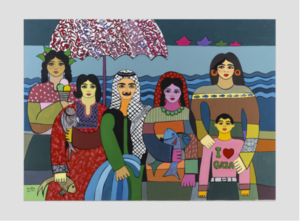
Opening on 22 October, Eltiqa: How to Work Together? presents the work of six artists from Eltiqa, an artist collective from Gaza City curated by The Question of Funding. For over 20 years, Eltiqa (Arabic for “encounter”) have developed artistic practices together while supporting younger generations of artists in Gaza. The agile, creative and community-orientated nature of their artistic practice and economic model has helped the group sustain itself through years of political, economic and cultural struggles.
Featuring more than 60 artworks by Mohamed Abusal, Abdel Raouf Al-Ajouri, Mohammed Al-Hawajri, Raed Issa, Dina Matar and Sohail Salem, the exhibition tells the story of a community that continues to overcome years of oppression. The exhibition includes an extensive timeline from 1948 to 2026, covering major events in Palestine in addition to key moments and in the lives and careers of Eltiqa members and the Eltiqa Gallery in Gaza.
Opening on 19 November, A Sea for Borrowed Time, is a major exhibition of contemporary Palestinian art in partnership with Sharjah Art Foundation. Bringing together works by leading Palestinian artists and others responding to Palestine – featuring Tarek Al-Ghoussein, Basma Al Sharif, Simone Fattal, Shadi Habib Allah, Rula Halawani, Hazem Harb, Khalil Rabah and Abdul Hay Mosallam Zarara – the exhibition examines how contemporary artists have responded to histories of political resistance, displacement, occupation, memory and solidarity through photography, sculpture, installation, film and painting.
Drawing on works from the Sharjah Art Foundation’s internationally significant collection, the exhibition explores the diversity of Palestinian artistic practice across generations. Rather than following a chronological approach, the exhibition moves between testimony, memory, lived experience and imagination, bringing together artists who have developed visual languages to address histories that continue to shape Palestinian life.
The exhibition includes a major focus on Abdul Hay Mosallam Zarara (1933-2020), a self-taught artist whose practice was deeply connected to the Palestinian struggle. A major figure in Palestinian modern art, the exhibition highlights Zarara’s contribution to the visual culture of Palestinian resistance and the international networks through which his work travelled, situating Palestine and Ireland within wider histories of solidarity, anti-colonial struggle and self-determination. At its centre is a recently acquired relief connected to Ireland, discovered in the artist’s studio shortly before his death and shown publicly for the first time, offering a striking connection between Palestinian artistic production and Irish histories of cultural and political solidarity.
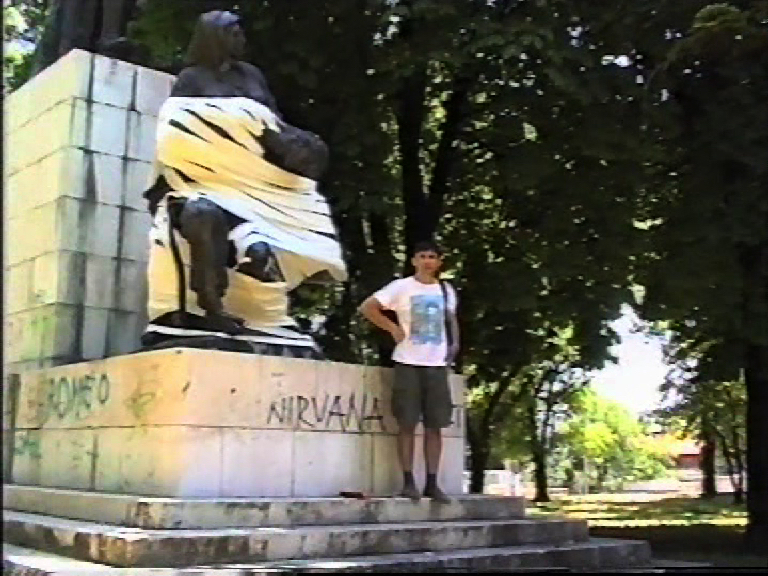
From 29 October an outdoor screening programme of film works, titled Is Everything and Everyone all the Time, curated by The Question of Funding will be screened on Living Canvas at IMMA in parallel with the exhibition Eltiqa: How to Work Together?. The programme brings together three films: Basma Alsharif’s We Began By Measuring Distance (2009), Rosalind Nashashibi’s Electrical Gaza (2015), and Oraib Toukan’s When Things Occur (2016) which focus on the impossibility of representing Gaza. Each film confronts, in a different way, this crisis of representation; the impossibility of communicating an experience shaped by siege, death, destruction, and separation when the available images themselves risk producing further distance. The films search for forms of intimacy, mediation, and address that might resist the familiar visual languages through which Gaza has been made legible to the outside world.
IMMA will also take part in Palestine Cinema Days on 2 November, an international showcase of Palestinian cinema that brings audiences together worldwide each year around Palestinian stories, memory, and lived experiences. This global initiative of 1,000 screenings will take place across the world in cinemas, universities, cultural centres and other venues. Now in its fourth year the theme of the 2026 festival is Cinema Across Borders. Stories Beyond Erasure. IMMA will screen a series of documentaries by Gazawyat, produced by Filmlab Palestine, directed by Khaled Tuaima, Moayed Abu Ammouneh, Shorouq Al-Aila and Aisha Adly.
The Question of Funding, curators of Eltiqa: How to Work Together?, said:
“As the curators of Eltiqa: How to Work Together?, the challenge of making this exhibition while the genocide continues to unfold was a daunting one. The physical feasibility of doing so was only made possible by the fact that some members of Eltiqa were able to flee Gaza, and that artworks were already dispersed geographically through solidarity networks or recently salvaged during the genocide. The question of whether exhibiting art from Gaza now normalises the ongoing genocide remains, for us, a dilemma”.
Curator Hoor Al Qasimi, Director, Sharjah Art Foundation, said:
“The artists in this exhibition have engaged with the occupation of Palestine and the displacement of its people, while shedding light on life that persists beyond rupture. By bringing together these works from the Sharjah Art Foundation Collection to IMMA, we wanted to share these stories with the wider public and form moments of resonance. We hope that this exhibition opens up a dialogue on land, colonial histories and resistance, as well as the importance of art as a carrier of memories across generations.”
Annie Fletcher, Director, IMMA, said:
“This special programme and the resulting collaborations reflects the value of cultural exchange and the possibilities that emerge when we connect different geographical, historical and artistic perspectives. At IMMA, we believe in the importance of presenting ambitious international programmes that challenge perspectives, and deepen our understanding of the world through contemporary art. These two exhibitions embody that commitment, creating space for dialogue, and new ways of seeing, while offering Irish audiences a rare opportunity to experience important Palestinian artworks”.
29 October 2026
ENDS
For media inquiries, please contact:
Monica Cullinane E: [email protected] T: 086 2010023
Patrice Molloy E: [email protected] T: 086 2009957
IMMA Press Office: E: [email protected]
Additional Notes for Editors
Programme details
Eltiqa: How to Work Together?
23 October 2026 – 21 February 2027
Further details visit Eltiqa: How to Work Together? exhibition – IMMA
Participating artists
Mohammad Al-Hawajri (b.1976, Gaza)
Raed Issa (b.1975, Gaza)
Dina Matar’s (b. 1985, Gaza)
Mohamed Abusal (b. 1976, Gaza)
Abdel Raouf Al-Ajouri (b.1977, Gaza)
Sohail Salem (b. 1974, Gaza)
Is Everything and Everyone all the Time, curated by The Question of Funding
Living Canvas at IMMA
29 October – 11 November 2026 / daily from 9.30am to 6.30pm
Featuring Basma Al Sharif’s We Began by Measuring Distance (2009), Oraib Toukan’s When Things Occur (2016) and Rosalind Nashashibi’s Electrical Gaza (2015).
This screening programme coincides with the Hyundai Tate Research Centre: Transnational annual symposium, Transnational Resistances (Tate Modern, 6-7 November 2026), in which IMMA is a partner. The Symposium brings together the practices of artists and academics working with communities in resisting erasure and challenging entrenched systems of power. The symposium is in dialogue with IMMA’s current programmes, and includes contribution by The Question of Funding. Transnational Resistances is organised by Hyundai Tate Research Centre: Transnational, in partnership with Hyundai Motor, in partnership with IMMA and Mathaf: Arab Museum of Modern Art. Available to live stream, further details visit Tate website here
About the Curator: The Question of Funding is a growing collective of cultural producers and community organisers from Palestine. By producing, documenting, accumulating, and disseminating resources, experience, and knowledge with their wider community, it aims to rethink the economy of funding and how it affects cultural production both in Palestine and the world. The Question of Funding members, curators for this exhibition are
Yazan Khalili is a Researcher, Visual Artist, Cultural Producer, and Lara Khaldi from Jerusalem, Palestine and currently based in Amsterdam, is the Director of the contemporary art space de Appel. Yazan Khalili’s research for this exhibition is part of his PhD work within IMAGINART – Imagining Institutions Otherwise: Art, Politics, and State Transformation, financed by the Dutch Research Council (NWO).
A Sea for Borrowed Time
بحر للزمان المستعار
19 November 2026 – 4 July 2027
Further details visit Sharjah Art Foundation Collection exhibition – IMMA
Participating artists
Tarek Al-Ghoussein (1972-2022, Kuwait)
Basma Al Sharif (b. 1983, Kuwait City)
Simone Fattal (b. 1942, Damascus, Syria
Shadi Habib Allah (b. 1977, Jerusalem, Palestine)
Rula Halawani (b. 1964, Jerusalem, Palestine
Hazem Harb (b. 1980, Gaza, Palestine)
Abdul Hay Mosallam Zarara (1933-2020, Hebron, Palestine)
Khalil Rabah (b. 1961, Jerusalem, Palestine)
A Sea for Borrowed Time is organised by IMMA and Sharjah Art Foundation and is curated by Hoor Al Qasimi.
About Sharjah Art Foundation
Sharjah Art Foundation is an advocate, catalyst and producer of contemporary art within the Emirate of Sharjah and the surrounding region, in dialogue with the international arts community. The Foundation advances an experimental and wide-ranging programmatic model that supports the production and presentation of contemporary art, preserves and celebrates the distinct culture of the region and encourages a shared understanding of the transformational role of art. The Foundation’s core initiatives include the long-running Sharjah Biennial, featuring contemporary artists from around the world; the annual March Meeting, a convening of international arts professionals and artists; grants and residencies for artists, curators and cultural producers; ambitious and experimental commissions and a range of travelling exhibitions and scholarly publications. www.sharjahart.org/en/
About Sharjah
Sharjah is the third largest of the seven United Arab Emirates, and the only one bridging the Arabian Gulf and the Gulf of Oman. Reflecting the deep commitment to the arts, architectural preservation and cultural education embraced by its ruler, Sheikh Dr Sultan bin Mohammad Al Qasimi, Sharjah is home to more than 20 museums and has long been known as the cultural hub of the United Arab Emirates. It was named UNESCO’s Arab Capital of Culture for 1998 and the UNESCO World Book Capital for 2019.
IMMA Opening Hours
Tuesday, Thursday, Friday, Saturday: 10am – 5.30pm
Wednesday: 11.30am – 5.30pm
Sunday: 12 noon – 5.30pm
Bank Holiday Mondays: 12 noon – 5.30pm
Admission: Free