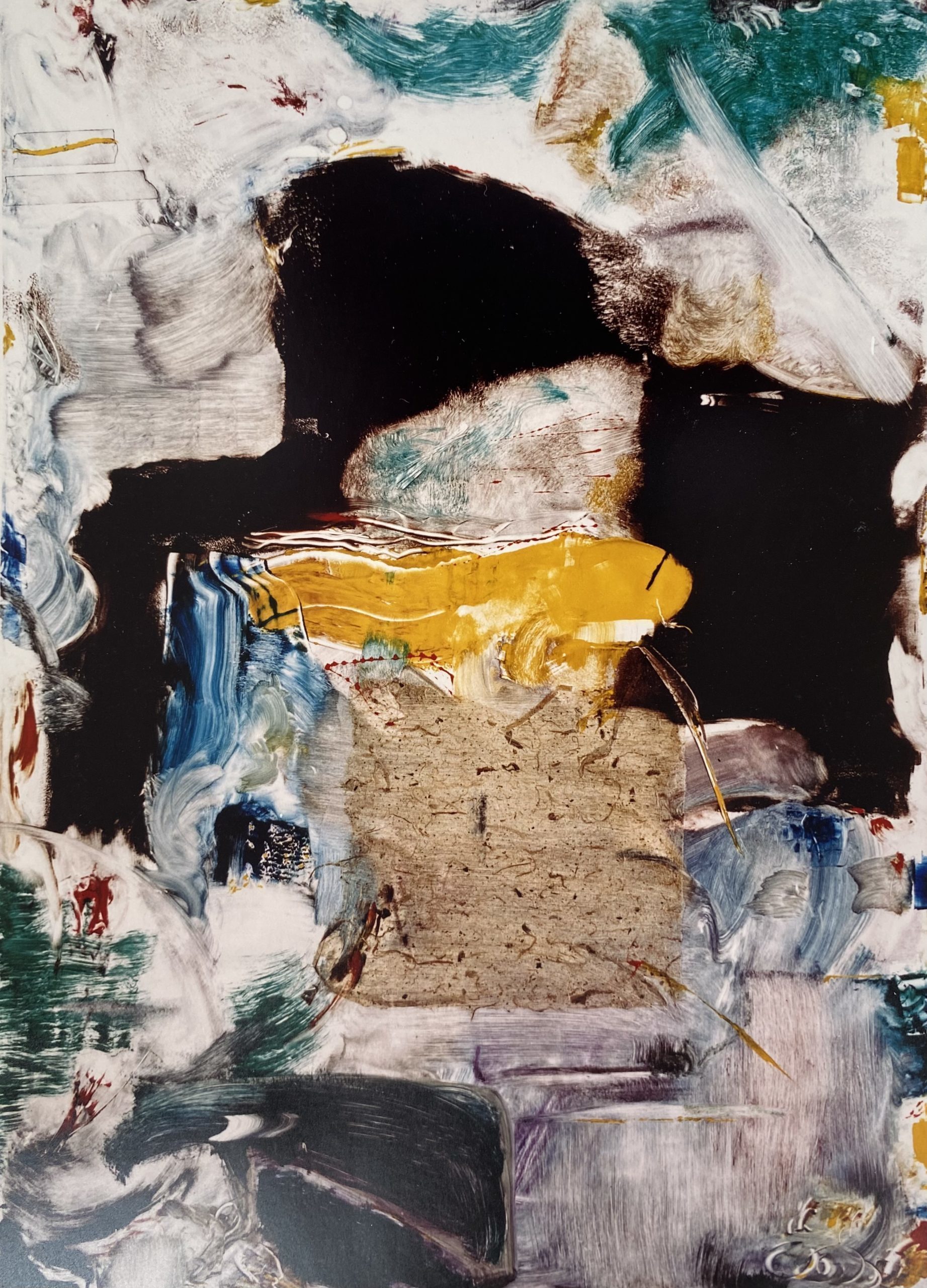
Six Pieces for Veronica, 1990
When Tiberius Caesar became ill, he sent his friend Volusianus to Jerusalem to bring back the miraculous physician Jesus. Upon learning that Jesus had already been unjustly put to death, he despaired that his mission had been in vain. His salvation and the salvation of the emperor came in the person of the lady Veronica. Veronicae contain healing powers, the spirit of Christ. Not unlike the shroud of Turin, the Veronicae are imbued with an aura of the miraculous.
The Irish artist Martin Mullin created a suite of monotypes dedicated to his deceased sister Veronica which also call forth the power of the miraculous. Mullin’s sister Veronica, not unlike her patron saint, was a woman of rare aesthetic sensibilities in-volved in good works, a champion of the oppressed, especially women and children. After a successful career as an international fashion model in London, Paris, and Spain, and a stint as Ireland’s first female television personality, she moved to the U.S. and began teaching in inner city schools in New Orleans. Later she taught English literature at S.U.N.Y. New Paltz and was much loved by her students. She was a gifted poet who had been accepted for doctor-al studies at Harvard shortly before her death.
For Mullin, an artist from Dromahair, his sister was the Irish muse at her best, a Beatrice who led him out of the Irish countryside and brought him into the world of the spirit, the world of Christian char-ity, and the life of the artist who knows no international boundaries. Following her death in Spain, Mullin came back to New York, and began working at the innovative Printmaking Workshop (P.M.W.) founded by Bob Blackburn in 1948. The P.M.W. is a place where the spirit of art and people of all backgrounds, ages, and colours flourish. It is a place which favours the charity and internationalism which was so important to Veronica Mullin. Martin Mullin flourished in this environment and began his first series of monotypes. Mullin is an intuitive artist who like Jackson Pollock has a quick and direct way of working. He is primarily a painter, so the monotype technique (one image lifted from a glass plate through transfer) was well-suited to Mullin. For Martin, the fast-printing method provided him with immediate emotional release. The image is surrendered to the press. With the element of chance involved, there is a certain ‘trusting in God’. Just as Saint Veronica takes the canvas and gives it over to Jesus, takes the moisture from His face, and is given an image.
In Six Pieces for Veronica, Japanese paper is applied in areas using chinecolle technique. Again, this calls forth the idea of the veil. The viewer is reminded of the cloth which wipes the brow. This image is rooted in the Irish psyche, and can be found in the work of Samuel Beckett in his poem Enueg II.
“world world world world
and the face grave
cloud against the evening
de morituris nihil nisi
and the face crumbling shyly
too late to darken the sky
blushing away into the evening
shuddering away like a gaffe
veronica mundi
veronica munda
give us a wipe for the love of Jesus”
Mullin had also been deeply touched by the images of Veronica with her veil in the Stations of the Cross by Henri Matisse (1950). For Mullin the death of his sister was very much like a station of the Cross. Implied in the suffering and passion was also a resurrection. His sister’s death, his own dark night of the soul following her death, brought Mullin into a new life as an artist. Not unlike Dante’s Beatrice, as he has experienced all the suffering one can bear, he is brought by her spirit into a new creative life. This was a pivotal point in the artist’s creative development. The monotype as a kind of painterly print, less cold than the more commercial medium of lithography, seems well suited to this intuitive and deeply spiritual artist. His muse has guided him well. With their patches of red recalling the blood of Christ, the passion of the bull fight (the bullfighter’s red cloth is called “veronica”), the monotypes dance and whirl before our eyes. Their mystical veils float one on top of another in the magical space within the picture plane. They become for the viewer a haunting abstract image suspended in a realm beyond time and space, between the relic of the Roman empire and the modern world. They become for us both relic and a carrier of healing pneuma. Mullin has used their presence to heal himself after his sister’s death, and this spirit is imparted to the viewer. Mullin with his sincerity has saved us from much of the cynicism found in some contemporary art and has brought us back to something which is the very heart and soul of Ireland.
Six Pieces for Veronica by Martin Mullin
Anne McCloy
7 October 1991
NYC
| Medium | Varies |
| Dimensions | Unframed |
| Credit Line | IMMA Collection: Donated by the artist, 1991 |
| Item Number | IMMA.20 |
| Copyright |
Martin Mullin Martin Mullin For copyright information, please contact the IMMA Collections team: [email protected]. |
| Tags |