IMMA presents a major exhibition pairing the distinct art practices of renowned artist Camille Souter and contemporary artist Alberta Whittle
23/02/2026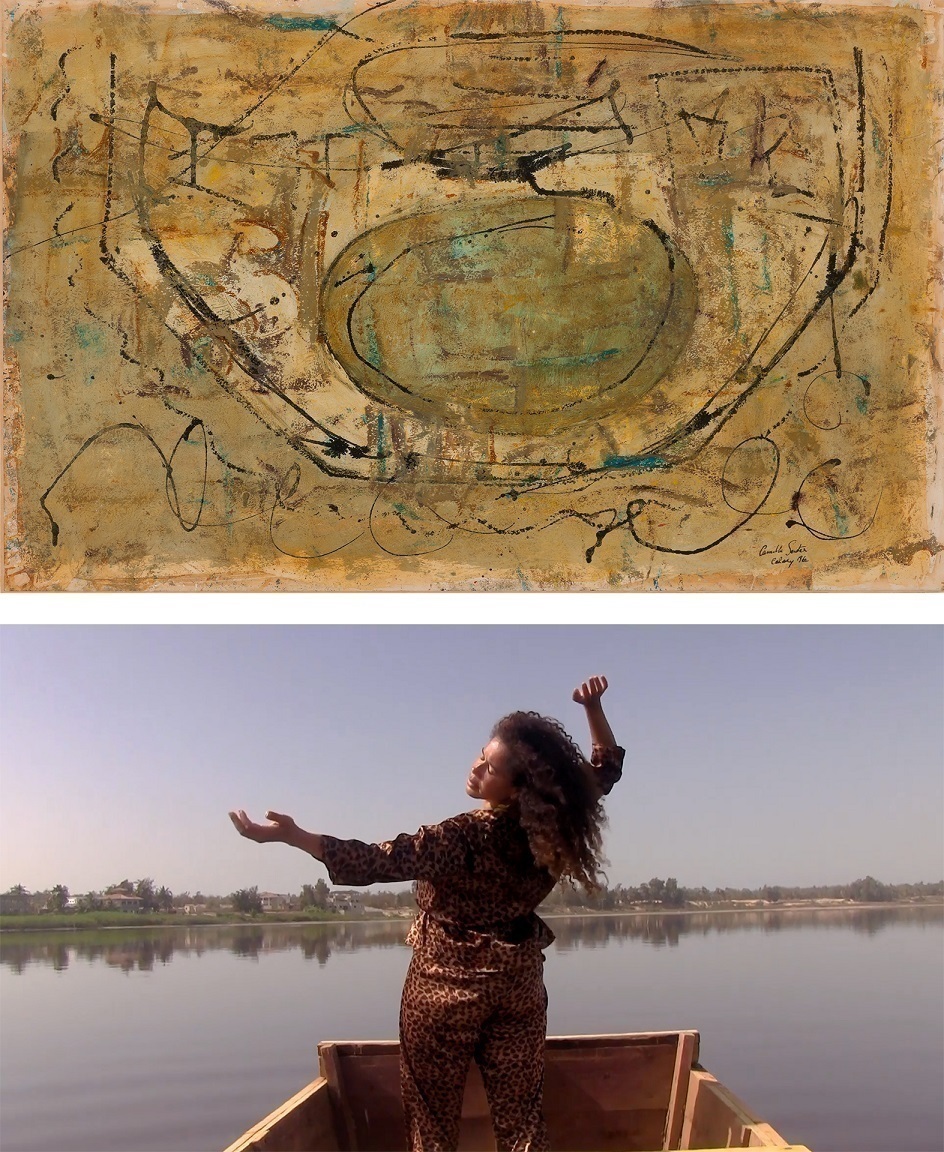
Fisherwoman, Fisherwoman brings together two distinct art practices – of painter Camille Souter (1929–2023) and contemporary artist Alberta Whittle (b. 1980) – that insist upon working against the grain. Spanning a period of 70 years, the works in this thematic exhibition range from painting, collage and watercolour to immersive film, sculptural installation and live performance. The exhibition opens at IMMA (Irish Museum of Modern Art) on Friday 6 March 2026.
One of the largest exhibitions of British-born, Irish artist Souter’s work to date, it features works-on-paper from the 1950s as well as one of her final paintings, alongside previously unseen archival materials and sketches by the artist. Installation works by Whittle have been specially reimagined and refabricated by the artist for IMMA’s galleries, including a new sculptural installation, in what is the first showing of the Barbadian Scottish artist’s practice in Ireland.
Where Souter and Whittle meet in Fisherwoman, Fisherwoman, we see layered intersections of ecological and humanitarian concerns. Both artists call attention to urgent issues of extraction and land use, geology and climate, industrialisation and labour, and movement and migration. They each create work from their own personal and local experiences, yet it is shaped by an unerring global awareness. At the same time, these artists’ practices are singular–they contrast in form and style to one another and hold different emphasis. Whittle leans towards the political, charging Souter’s prescient socially engaged works, while Souter’s intense care and curiosity for the natural world extends Whittle’s in turn. These different levels of emphasis bring nuance and texture to the exhibition, adding a productive complexity for visitors to unfold from their own position.
Among the key works on display, Souter’s unflinching painting The slaughtered cow, ten minutes dead (1973), as well as her war series paintings, Desert Shield–Gulf War (1991) and We don’t want to see blood (2004), are significant. Whittle’s search for refuge in an increasingly unstable world in between a whisper and a cry (2019) and her calls for care as resistance in Invest in Love (2020) similarly ask us to bear witness to the raw hostility of humanity, but never without tenderness and empathy. There is a sense of searching for a means for restoration and transformation, be it in the face of exploitation of land for economic gain or destroyed ancestral legacies. Paintings by Souter such as The Last of the Radicio (1964) and Forgotten Island near Venice (1964) criticise humanity’s failure to respect our natural resources. Whittle’s work asks us to confront unsettling realities: in the words of writer Ama Josephine Budge, to “dive in and re/collect ourselves, if necessary, bone by bone.”
Works reimagined by Whittle for the exhibition include RESET (2021), shown in an expanded form with installation elements on show in IMMA’s galleries, the film screened outdoors, and a live performance taking place on IMMA’s grounds. Her coil work Totems of Brass (Part one) (2023) has been dramatically extended in length in response to the architecture of IMMA’s House Galleries, while installation Belly of the beast ((continuing echoes from across the water)) (2026), has been entirely refabricated for the space of the exhibition, and the multimedia installation between a whisper and a cry (2019) is now accompanied by a new, related sculptural installation titled Memorial for “The Great Carew” aka Neville Denis Blackman (sargassum hues) (2019–2026).
Carnival, poetry and magic are bearers of wayward joys and hope in the exhibition. Souter’s Make Believe of all this Winter (1964) and Whittle’s Only the magic and the dream are true (2023) hang side-by-side in synergy, and likewise Finding Pleasure in my Diamonds (2023) by Whittle speaks back to Souter’s Buon Divertimento Chioggia (1958). While these artists are unafraid of the darkness of humanity, they also seek fissures where joy and light seeps through to dream and make-believe new ways of being. In this way, these women become fishers. Diving into cracks to unearth silenced or wilfully forgotten truths, both past and present, they conjure up better worlds for us, on a search for truth, respect, justice and love.
Curator Rachael Gilbourne said, “Fisherwoman, Fisherwoman tells a story of courage and compassion. Through the work of Souter and Whittle, we confront the traumas of our time – from the plundering of the earth and the oceans to the terror of war and colonialisation – yet their voices swell with empathy and a careful hope for the future. It is a real privilege to listen and learn from these artists. They call for curiosity and complexity in the face of monoculture and hype. We hope the exhibition offers the freedom to think deeply, and to imagine strategies of nuance and co-existence.”
Alberta Whittle said, “Working with the memory of Camille Souter and her creative legacy has been fascinating and inspiring. Her approach to radical thinking through her brush has shadowed me in my own studio practice across the water in Glasgow. I am grateful for the opportunity to think expansively with her children, curator Rachael Gilbourne and the wonderful IMMA team.”
Coinciding with the preview of Fisherwoman, Fisherwoman on 5 March, IMMA Talks presents a roundtable conversation exploring the exhibition’s themes and the practices of artists Camille Souter and Alberta Whittle. Speakers include artist Alberta Whittle, art historian Dr Sarah Kelleher, and curator Rachael Gilbourne.
Whittle’s film RESET (2020) will be screened on Living Canvas at IMMA at key moments over the duration of the show, and on 21 June, Whittle’s performance work RESET (2021–2026), with choreographer and performer Mele Broomes, will take place live across the museum’s grounds to celebrate the Solstice, as part of Summer at IMMA.
A wider public programme of related workshops and screenings will also run in parallel with the exhibition.
The exhibition is accompanied by a limited edition sculpture by Alberta Whittle in cast glass, Summoning spirit – building a new vessel (2026), issued as a varied edition of 11 plus 4 artist’s proofs.
ENDS
For media inquiries, please contact:
Monica Cullinane E: [email protected] T: 086 2010023
Patrice Molloy E: [email protected] T: 086 2009957
Additional Notes for Editors
Exhibition details
Fisherwoman, Fisherwoman: Camille Souter & Alberta Whittle
6 March 2026 – 13 September 2026
Admission Free
Webpage: Fisherwoman, Fisherwoman: Camille Souter & Alberta Whittle
Opening Hours
Tuesday, Thursday, Friday, Saturday: 10am – 5.30pm
Wednesday: 11.30am – 5.30pm
Sunday: 12noon – 5.30pm
Bank Holiday Mondays: 12noon – 5.30pm
Exhibition Opening:
Thursday 5 March: 6.00 – 8.00pm
IMMA Talk
Thursday 5 March: 5.30pm
Coinciding with the preview of ‘Fisherwoman, Fisherwoman’ IMMA Talks presents a roundtable conversation exploring the exhibition’s themes and the practices of artists Camille Souter and Alberta Whittle. Speakers include artist Alberta Whittle, art historian Dr Sarah Kelleher, and curator Rachael Gilbourne. Admission free, book online
About Camille Souter (1929–2023) b. Northampton, England; lived and worked predominantly in Achill, Co. Mayo
Camille Souter was raised in Ireland and originally trained as a nurse at Guy’s Hospital London, before taking up painting in the mid-1950s. From early works, often abstract in appearance yet always subject-based, to more representational figurative work that came later, Souter’s endless curiosity in the journey of life is a constant. Her work is firmly based within reality, the everyday and, more often than not, the extraordinary everyday depicted in its sheer simplicity. Often working in series, recurring themes have included flight and the mechanics of flying, carnivals and circus, landscape and weather, the destruction of war, extraction and industry, raw meat and medical notes.
Souter is the recipient of numerous awards from the Prix de Ville de Monaco (1977) to the IMMA Glen Dimplex award for contribution to visual arts in Ireland (2000). She was an Honorary member of the RHA and was elected Saoi of Aosdána in 2009. In 2015, Trinity College Dublin awarded her an honorary doctorate. Her works can be seen in many public and private collections including the National Gallery of Ireland, Hugh Lane Municipal Gallery, Ulster Museum, and the Arts Council of Ireland. Souter’s work within IMMA Collection is regularly exhibited at IMMA, as well as at venues national and international.
Souter exhibited extensively from the 1960s onwards and represented Ireland at the Paris Biennale (1961). Major retrospectives of her work were held at Douglas Hyde Gallery, Dublin (1980); Ulster Museum, Belfast (2000); and more recently at Custom House Studios, Mayo (2019), in celebration of the artist’s 90th year.
About Alberta Whittle b. 1980 Bridgetown Barbados; lives and works in Glasgow, Scotland
Barbadian-Scottish artist Alberta Whittle’s multifaceted practice is preoccupied with developing a personal response to the legacies of the Atlantic slave trade, unpicking its connections to institutional racism, white supremacy and climate emergency in the present. Against an oppressive political background Whittle aims to foreground hope and engage with different forms of resistance.
Whittle received her MFA from the Glasgow School of Art (2011); PhD at the University of Edinburgh (2024); and is currently a Research Associate at The University of Johannesburg. She has exhibited and performed in various solo and group shows internationally and represented Scotland in the 59th Venice Biennale (2022). She is the recipient of numerous awards including the Margaret Tait Award winner (2018/19); a Turner Bursary, Frieze Artist Award and Henry Moore Foundation Artist Award (2020); and Paul Hamlyn Award for Artists (2022).
Recent solo exhibitions and performances include: ‘Under the skin of the ocean, the thing urges us up wild’, Mount Stuart, Isle of Bute, Scotland (2024); ‘between a whisper and a cry’, Institute of Contemporary Art, Los Angeles (2023); and ‘create dangerously’, Modern One, Scottish National Gallery of Modern Art, Edinburgh (2023). Her work has been acquired by the UK National Collection; National Galleries of Scotland; Tate, London; Barbados National Art Gallery; and Glasgow Museums Collection.